
Abstract
Objective
To examine whether laboratory tumor lysis syndrome (TLS) is associated with 28-day mortality in critically ill cancer patients after adjustment for illness severity. Secondary outcomes included acute kidney injury (AKI), renal replacement therapy (RRT), and 90-day mortality.
Material and Methods
This retrospective study used the Medical Information Mart for Intensive Care IV (MIMIC-IV) v3.1 database. Of 11,082 adults with hematologic or solid malignancy at their first intensive care unit admission, 974 whose uric acid, potassium, phosphate, and calcium were measured within 72 hours were included. Laboratory TLS was defined using an adaptation of the Cairo-Bishop laboratory criteria, based on absolute thresholds (at least two of the four criteria). Creatinine was excluded from the definition so that AKI could be examined separately. Associations were assessed by logistic regression adjusted for age, sex, cancer type, Sequential Organ Failure Assessment score, Charlson index, sepsis, and baseline creatinine, and by propensity score matching.
Results
Laboratory TLS was present in 284 patients (29.2%). Twenty-eight-day mortality was 52.5% in TLS-positive patients and 30.3% in TLS-negative patients. After adjustment, TLS remained associated with mortality [odds ratio (OR): 1.71; 95% confidence interval (CI): 1.21-2.41; p=0.002], AKI (OR: 1.68; 95% CI: 1.13-2.54), and RRT (OR: 2.25; 95% CI: 1.40-3.62). The adjusted association with 90-day mortality did not reach statistical significance (OR: 1.39; 95% CI: 0.99-1.95). The risk of AKI was markedly higher in patients meeting three or more criteria (OR: 5.40; 95% CI: 2.10-18.42). The association with mortality persisted among 235 propensity-matched pairs (OR: 1.68; 95% CI: 1.17-2.40). Among the individual criteria, only hyperuricemia remained associated with mortality when all four were modeled together (OR: 1.83; 95% CI: 1.28-2.62).
Conclusion
Among critically ill cancer patients, laboratory TLS was associated with short-term mortality and AKI after adjustment for measured covariates. Whether this routinely available measure adds prognostic value beyond established severity scores requires further investigation.
Keywords: Tumor lysis syndrome, intensive care units, acute kidney injury, neoplasms, mortality
INTRODUCTION
Tumor lysis syndrome (TLS) is an oncologic emergency caused by the rapid breakdown of tumor cells and the release of intracellular contents into the circulation. Hyperuricemia, hyperkalemia, hyperphosphatemia, and hypocalcemia are its laboratory components.1 The Cairo-Bishop classification distinguishes laboratory from clinical TLS. The clinical picture may include acute kidney injury (AKI), cardiac arrhythmia, and seizures.- Most of the TLS literature has focused on hematologic malignancies and the period after cytotoxic treatment.- Cancer patients, however, are increasingly admitted to the intensive care unit (ICU),, where TLS is among the metabolic emergencies encountered. Few studies have examined the prognostic value of laboratory TLS independent of illness severity in a mixed cancer population in the ICU.
We examined whether laboratory TLS was associated with 28-day mortality in cancer patients admitted to the ICU. As secondary outcomes, we examined AKI, renal replacement therapy (RRT), and 90-day mortality.
MATERIAL AND METHODS
Study Design and Data Source
This retrospective cohort study used the Medical Information Mart for Intensive Care IV (MIMIC-IV) v3.1 database, which contains deidentified clinical data of patients admitted to Beth Israel Deaconess Medical Center (Boston, USA) between 2008 and 2022 and is available through PhysioNet. The creation of the database was approved by the Institutional Review Boards of the Massachusetts Institute of Technology and Beth Israel Deaconess Medical Center, and the requirement for individual informed consent was waived because the data were deidentified. The study was also approved by the Antalya Training and Research Hospital Scientific Research Ethics Committee of one (approval number: 15/20, date: 4 September 2026). The data were accessed by an author who had completed the required training (Collaborative Institutional Training Initiative, Data or Specimens Only Research) and had signed the data use agreement. Reporting followed the Strengthening the Reporting of Observational Studies in Epidemiology (STROBE) recommendations.
Study Population
We evaluated patients aged 18 years or older with a hematologic or solid malignancy who were admitted to the ICU for the first time. Malignancy was identified using ICD-9 codes (140-208) and ICD-10 codes (C00-C96 and D45-D47) in hospital admission diagnoses. Hematologic malignancies were defined by ICD-9 codes 200-208 and ICD-10 codes C81-C96 and D45-D47; under ICD-10, this definition includes myelodysplastic syndromes and myeloproliferative neoplasms. Malignancies without these codes were classified as solid tumors. Because laboratory TLS can only be assessed when all four analytes are available, patients were required to have uric acid, potassium, phosphate, and calcium measured at least once within the first 72 hours after ICU admission. A total of 974 patients met these criteria ().
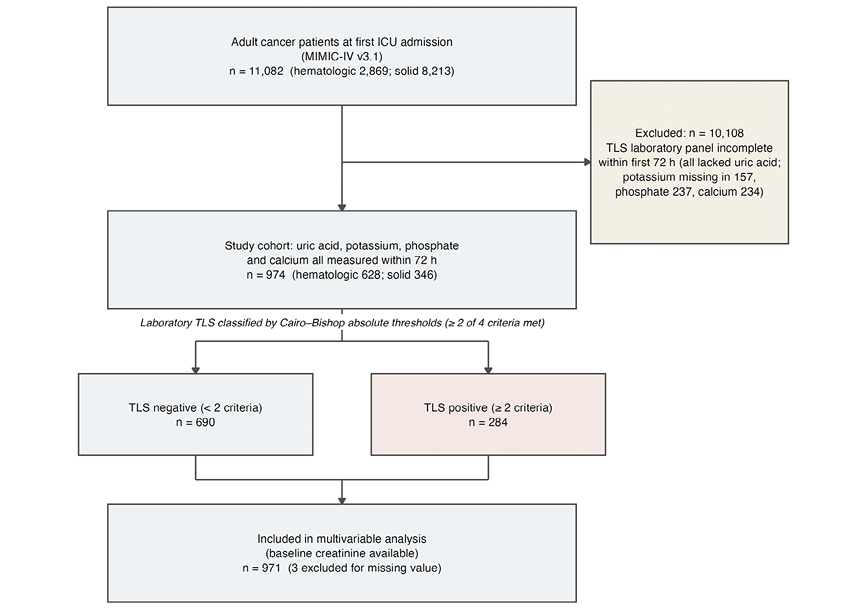
Cohort derivation. Of 11,082 adult cancer patients at first ICU admission in MIMIC-IV v3.1, 974 had uric acid, potassium, phosphate and calcium all measured within the first 72 hours and formed the study cohort. All excluded patients lacked a uric acid measurement. ICU: Intensive care unit; TLS: Tumor lysis syndrome.
Definition of TLS
Laboratory TLS was defined by adapting the Cairo-Bishop laboratory criteria to use only absolute threshold values.1 The option of a 25% change from baseline in the original classification was not used. Patients were considered TLS-positive when at least two of the following were met within the first 72 hours: uric acid ≥8 mg/dL (476 µmol/L), potassium ≥6 mmol/L, phosphate ≥4.5 mg/dL (1.45 mmol/L) and corrected calcium ≤7 mg/dL (1.75 mmol/L). Laboratory values were obtained from hospital laboratory records of blood specimens, and the highest values of uric acid, potassium, and phosphate and the lowest value of total calcium within the first 72 hours were used. Therefore, the criteria did not need to be met simultaneously, and abnormalities recorded at different times within this window could be combined. The implications of this choice for classification are considered in the Discussion. In patients with an albumin measurement, calcium was corrected with the Payne formula [measured calcium + 0.8 × (4.0 − albumin in g/dL)] using the mean albumin of the first 72 hours, whereas measured calcium was used when albumin was unavailable. Creatinine elevation, a component of the clinical TLS definition, was deliberately excluded so that AKI could be examined as an independent outcome.
Outcomes
The primary outcome was 28-day mortality following ICU admission. Secondary outcomes were AKI according to the Kidney Disease: Improving Global Outcomes (KDIGO) criteria, RRT and 90-day mortality. AKI was assessed using KDIGO staging, which combines creatinine, urine output, and renal replacement criteria; the highest stage reached during the ICU stay was used, and stage 1 or higher was considered AKI. Baseline creatinine was defined as the lowest serum creatinine measured during the ICU stay or in the 7 days before it. RRT was defined as any documented renal replacement therapy during the ICU stay.
Statistical Analysis
Continuous variables were summarized as median (interquartile range), and categorical variables were summarized as number (percentage); groups were compared using the Mann-Whitney U and chi-square tests. Associations between TLS and outcomes were examined with multivariable logistic regression. Models were adjusted for age, sex, cancer type, Sequential Organ Failure Assessment (SOFA) score in the first 24 hours of ICU admission, Charlson comorbidity index, sepsis according to the Sepsis-3 definition and baseline creatinine.- A dose-response relationship was assessed according to the number of criteria met (0-1, 2, ≥3). The association between TLS and 28-day mortality was also examined among patients with hematologic and solid malignancies. We also tested whether the effect of TLS on mortality differed between hematologic and solid malignancies by adding to the model a product variable that allows the effect of TLS to vary by cancer type (interaction term). In an exploratory analysis, each of the four laboratory criteria was examined separately, and then all were examined together in a single adjusted model. In sensitivity analyses,TLS was redefined using three narrower definitions, and the association with mortality was retested for each definition: (1) at least two of uric acid, potassium, and phosphate with the calcium criterion removed; (2) both the uric acid and potassium criteria were met; and (3) the standard definition with the uric acid criterion required. These analyses were intended to show whether the association could be explained by electrolyte changes secondary to renal dysfunction. Propensity score matching was also performed. The propensity score was estimated by logistic regression using the same covariates, and one-to-one nearest-neighbor matching was performed with a caliper of 0.2 standard deviations of the propensity score, applied on the probability scale rather than on the logit scale. Balance after matching was assessed using standardized mean differences, and standard errors in the matched cohort were clustered by matched pairs. Three patients who had missing baseline creatinine values were excluded from multivariable analyses (n=971). Analyses were performed with R 4.5.1 (R Foundation for Statistical Computing, Vienna, Austria) using the packages dplyr 1.1.4, broom 1.0.12, ggplot2 4.0.0, gtsummary 2.5.0, MatchIt 4.7.219 and sandwich 3.1.1. A two-sided p<0.05 was considered statistically significant.
RESULTS
Of the 11,082 adult cancer patients screened at their first ICU admission, 10,108 were excluded because not all four laboratory parameters were measured within the first 72 hours. All excluded patients lacked a uric acid measurement. A total of 974 patients were included (). Of these, 628 (64.5%) had a hematologic malignancy and 346 (35.5%) had a solid malignancy. Laboratory TLS was present in 284 patients (29.2%). The frequency of TLS was similar between the hematologic and solid groups (27.2% vs. 32.7%; p=0.087). Among TLS-positive patients, the most frequently met criteria were hyperphosphatemia (97.2%) and hyperuricemia (86.3%). Hyperkalemia was present in 33.1% and hypocalcemia in 12.3%.
Baseline characteristics are shown in . Age and sex distributions were similar between the groups. TLS-positive patients presented with more severe illness. The median SOFA score was 7 (5-10) in the TLS-positive group and 5 (2-7) in the TLS-negative group (p<0.001). Simplified Acute Physiology Score II, Charlson index, frequency of sepsis, and baseline creatinine were also higher in the TLS-positive group.
TABLE 1: Baseline characteristics by laboratory TLS status.
| Characteristic | TLS positive (n=284) | TLS negative (n=690) | p-value |
|---|---|---|---|
| Age, years | 67.0 [60.0-76.0] | 68.0 [58.0-76.0] | 0.277 |
| Female sex, n (%) | 111 (39.1) | 311 (45.1) | 0.100 |
| Hematologic malignancy, n (%) | 171 (60.2) | 457 (66.2) | 0.087 |
| SOFA score (first 24 h) | 7.0 [5.0-10.0] | 5.0 [2.0-7.0] | <0.001 |
| SAPS II | 53.0 [43.0-65.0] | 43.0 [35.0-53.0] | <0.001 |
| Charlson comorbidity index | 7.5 [5.0-10.0] | 6.5 [4.0-9.0] | <0.001 |
| Sepsis (Sepsis-3), n (%) | 156 (54.9) | 258 (37.4) | <0.001 |
| Baseline creatinine, mg/dL | 1.3 [0.9-1.9] | 0.8 [0.6-1.1] | <0.001 |
| Maximum uric acid, mg/dL | 10.0 [8.6-12.4] | 4.8 [3.3-6.2] | <0.001 |
| Maximum potassium, mmol/L | 5.3 [4.6-6.3] | 4.4 [4.1-4.8] | <0.001 |
| Maximum phosphate, mg/dL | 6.4 [5.3-8.0] | 4.0 [3.3-4.7] | <0.001 |
| Minimum corrected calcium, mg/dL | 8.2 [7.6-8.9] | 8.5 [8.0-9.0] | <0.001 |
Values are median [interquartile range] unless stated. Corrected calcium by the Payne formula where albumin was available. To convert to SI units, multiply creatinine by 88.4 (µmol/L), uric acid by 59.48 (µmol/L), phosphate by 0.3229 (mmol/L) and calcium by 0.2495 (mmol/L). TLS: Tumor lysis syndrome; SOFA: Sequential organ failure assessment; SAPS II: Simplified Acute Physiology Score II.
Twenty-eight-day mortality was 52.5% (149/284) in the TLS-positive group and 30.3% (209/690) in the TLS-negative group (p<0.001). The unadjusted odds ratio (OR) was 2.54 [95% confidence interval (CI): 1.91-3.38]. In the multivariable model, TLS remained associated with 28-day mortality after adjustment (adjusted OR: 1.71; 95% CI: 1.21-2.41; p=0.002)
(, ). All model variables are presented in . In the adjusted model, solid malignancy (OR 2.46 compared with hematologic malignancy; 95% CI: 1.72-3.55), age, SOFA score, and Charlson index were also associated with mortality.
TABLE 2: Outcomes by laboratory TLS status.
| Outcome | TLS positive, n (%) | TLS negative, n (%) | Unadjusted OR (95% CI) | Adjusted OR (95% CI) | p value (adjusted) |
|---|---|---|---|---|---|
| 28-day mortality | 149 (52.5) | 209 (30.3) | 2.54 (1.91-3.38) | 1.71 (1.21-2.41) | 0.002 |
| 90-day mortality | 172 (60.6) | 302 (43.8) | 1.97 (1.49-2.62) | 1.39 (0.99-1.95) | 0.061 |
| In-hospital mortality | 131 (46.1) | 173 (25.1) | 2.56 (1.92-3.42) | 1.77 (1.25-2.50) | 0.001 |
| Acute kidney injury (any stage) | 239 (84.2) | 460 (66.7) | 2.66 (1.88-3.83) | 1.68 (1.13-2.54) | 0.012 |
| Renal replacement therapy | 64 (22.5) | 46 (6.7) | 4.07 (2.71-6.16) | 2.25 (1.40-3.62) | <0.001 |
Adjusted for age, sex, cancer type, SOFA score, Charlson comorbidity index, sepsis and baseline creatinine (n=971; 3 patients excluded for missing baseline creatinine). OR: Odds ratio; CI: Confidence interval; TLS: Tumor lysis syndrome.
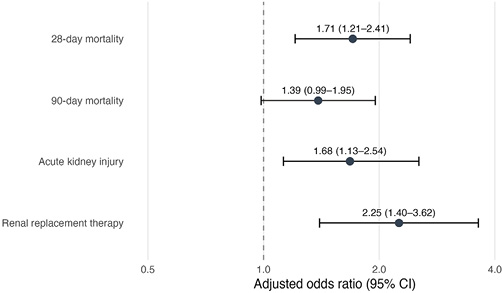
Adjusted association of laboratory TLS with 28-day mortality, 90-day mortality, acute kidney injury and renal replacement therapy. Points are adjusted odds ratios and error bars are 95% confidence intervals (logarithmic scale). Models were adjusted for age, sex, cancer type, SOFA score, Charlson comorbidity index, sepsis and baseline creatinine. TLS: Tumor lysis syndrome; SOFA: Sequential Organ Failure Assessment.
TABLE 3: Multivariable logistic regression for 28-day mortality (n=971).
| Variable | Adjusted OR (95% CI) | p-value |
|---|---|---|
| Laboratory TLS | 1.71 (1.21-2.41) | 0.002 |
| Age, per year | 1.02 (1.01-1.03) | 0.004 |
| Male sex | 1.17 (0.87-1.58) | 0.306 |
| Solid malignancy (vs hematologic) | 2.46 (1.72-3.55) | <0.001 |
| SOFA score, per point | 1.22 (1.17-1.27) | <0.001 |
| Charlson index, per point | 1.10 (1.03-1.18) | 0.006 |
| Sepsis (Sepsis-3) | 1.06 (0.78-1.44) | 0.689 |
| Baseline creatinine, per mg/dL | 0.88 (0.75-1.01) | 0.085 |
OR: Odds ratio; CI: Confidence interval; TLS: Tumor lysis syndrome; SOFA: Sequential organ failure assessment.
AKI developed in 84.2% of TLS-positive patients and 66.7% of TLS-negative patients, and stage 2-3 AKI occurred in 61.3% of TLS-positive patients and 44.9% of TLS-negative patients. After adjustment, TLS was associated with both AKI (OR: 1.68; 95% CI: 1.13-2.54; p=0.012) and RRT (OR: 2.25; 95% CI: 1.40-3.62; p<0.001) (). RRT was required in 22.5% of TLS-positive patients and 6.7% of TLS-negative patients; in-hospital mortality was 46.1% and 25.1%, respectively (adjusted OR: 1.77; 95% CI: 1.25-2.50; p=0.001) (). Ninety-day mortality was higher in the TLS-positive group (60.6% vs. 43.8%), although the adjusted association did not reach statistical significance (OR: 1.39; 95% CI: 0.99-1.95; p=0.061). Median ICU length of stay was longer in TLS-positive patients (2.8 vs. 2.0 days; p<0.001).
The frequency of AKI increased stepwise with the number of criteria met (66.7% with 0-1 criteria, 80.3% with 2 criteria and 94.7% with ≥3 criteria). In the adjusted analysis, the risk of AKI was markedly higher in patients with ≥3 criteria (OR: 5.40; 95% CI: 2.10-18.42; p=0.002) (, ). For 28-day mortality, the OR was 1.71 (95% CI: 1.17-2.50) with 2 criteria and 1.69 (95% CI: 0.96-3.00) with ≥3 criteria ().
TABLE 4: Acute kidney injury and 28-day mortality by number of TLS criteria met.
| TLS criteria met | n | AKI, n (%) | AKI, adjusted OR (95% CI) | 28-day mortality, n (%) | 28-day mortality, adjusted OR (95% CI) |
| 0-1 | 690 | 460 (66.7) | 1 (reference) | 209 (30.3) | 1 (reference) |
| 2 | 208 | 167 (80.3) | 1.32 (0.87-2.04) | 106 (51.0) | 1.71 (1.17-2.50) |
| ≥3 | 76 | 72 (94.7) | 5.40 (2.10-18.42) | 43 (56.6) | 1.69 (0.96-3.00) |
Adjusted for age, sex, cancer type, SOFA score, Charlson comorbidity index, sepsis and baseline creatinine (n=971; 3 patients excluded for missing baseline creatinine). OR: Odds ratio; CI: Confidence interval; TLS: Tumor lysis syndrome; AKI: Acute kidney injury.
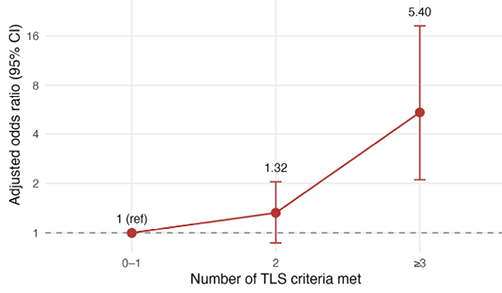
Adjusted odds ratio for acute kidney injury by number of TLS criteria met (reference: 0-1 criteria; logarithmic scale). Error bars are 95% confidence intervals. Adjustment as in Figure 2. TLS: Tumor lysis syndrome.
Propensity score matching paired 235 TLS-positive patients with 235 TLS-negative patients. After matching, the standardized mean difference was ≤0.10 for all covariates. In the matched cohort, 28-day mortality was 52.8% in the TLS-positive group and 40.0% in the TLS-negative group (OR: 1.68; 95% CI: 1.17-2.40; p=0.005). The association with AKI also persisted in the matched cohort (OR: 1.60; 95% CI: 1.02-2.49; p=0.039). In sensitivity analyses, the association with mortality was preserved across all three narrower definitions. The OR was 1.86 (95% CI: 1.31-2.64) when the calcium criterion was removed, 1.84 (95% CI: 1.02-3.38) when both the uric acid and the potassium criteria were required, and 1.90 (95% CI: 1.33-2.73) when the uric acid criterion was required.
The association between TLS and 28-day mortality was in the same direction for hematologic malignancies (adjusted OR: 1.53; 95% CI: 0.99-2.35) and solid malignancies (adjusted OR: 2.19; 95% CI: 1.20-4.02), and the effect of TLS did not differ between the two cancer types (interaction p=0.34). In the exploratory analysis of individual criteria, hyperuricemia (adjusted OR: 1.99; 95% CI: 1.42-2.79), hyperkalemia (adjusted OR: 1.64; 95% CI: 1.01-2.66), and hyperphosphatemia (adjusted OR: 1.44; 95% CI: 1.05-1.98) were each associated with 28-day mortality. Hypocalcemia was not associated (adjusted OR: 0.61; 95% CI: 0.31-1.15). When the four criteria were entered into the same model, only hyperuricemia remained associated with mortality (adjusted OR: 1.83; 95% CI: 1.28-2.62; p=0.001).
DISCUSSION
In this mixed cohort of cancer patients in the ICU, laboratory TLS was present in 29.2% of patients and associated with 28-day mortality after adjustment for age, sex, cancer type, SOFA score, Charlson index, sepsis, and baseline creatinine. The association held in propensity-matched pairs and under three narrower TLS definitions and was accompanied by higher rates of AKI and RRT. The stepwise increase in AKI frequency with the number of criteria met supports the internal consistency of these findings.
Laboratory TLS was present in nearly one-third of our cohort. Published frequencies vary widely with the population studied and the definition used. In adults with acute lymphoblastic leukemia, for example, TLS was recorded in 30.4% during induction, and TLS with associated AKI has been studied prospectively in high-risk hematology patients in the rasburicase era. Two features of our design are likely to have contributed to the high frequency. Only patients who had all four laboratory parameters measured were included, which may have preferentially selected patients already suspected of TLS. Only 8.8% of the screened patients had all four parameters measured. Beyond this selection, the ICU population represents a group with high severity of illness.
Twenty-eight-day mortality reached 52.5% in TLS-positive patients, and the association between TLS positivity and mortality persisted after adjustment. Population-based inpatient data from the United States have reported in-hospital mortality of 32% in admissions with TLS, and the burden of TLS has been described at the national level using the same data source. These studies rely on hospital discharge records, which do not contain physiological severity scores such as SOFA; therefore, adjustment for illness severity remains limited. Our results are consistent with these reports. In addition, the association persisted after adjustment for established markers of severity, such as SOFA score, Charlson index, and sepsis. The association was also in the same direction for hematologic and solid malignancies, with no indication that the effect of TLS differed between the two cancer types. The adjusted odds of mortality were higher in patients with solid malignancies than in those with hematologic malignancies, which may reflect the fact that patients with solid tumors are often admitted to the ICU at a more advanced stage of disease.
TLS was associated with both AKI and RRT in our cohort, and the frequency of AKI increased stepwise with the number of criteria met, with a markedly higher adjusted risk in patients with three or more criteria. In patients with TLS admitted to the ICU for urgent chemotherapy, AKI has been reported in 80.4% and RRT in 54.2%,23 and the 84.2% AKI rate among our TLS-positive patients is in line with that report. Our data do not establish the temporal sequence between the laboratory abnormalities and AKI. Both were assessed within the same ICU stay, and AKI may have preceded or coincided with the laboratory abnormalities because hyperkalemia, hyperphosphatemia, and hypocalcemia can also result from reduced renal clearance. The association is also biologically plausible. Uric acid may contribute to kidney injury through crystal-independent pathways in addition to crystal deposition,, and hyperphosphatemia may aggravate tubular injury through calcium-phosphate precipitation. Since AKI itself has been associated with mortality in cancer patients,, at least part of the TLS-mortality association may be shared with or mediated by renal dysfunction.
The association with mortality was preserved under all three sensitivity definitions, including the narrow definition requiring the uric acid criterion. These analyses were planned in response to a concern about circularity, because hyperkalemia, hyperphosphatemia, and hypocalcemia may also develop as consequences of renal dysfunction; the creatinine criterion of the clinical TLS definition overlaps with AKI. The persistence of the association, when uric acid, the most specific marker of tumor lysis, was required, suggests that the observed association is not merely a metabolic reflection of renal dysfunction. The exploratory analysis of individual criteria points in the same direction: hyperuricemia was the only component that remained associated with mortality when all four criteria were modeled together. Whether laboratory TLS carries prognostic weight on its own is still debated. In adults with acute lymphoblastic leukemia, laboratory TLS followed a milder course than clinical TLS, and in a MIMIC-IV-based conference abstract restricted to hematologic malignancies, no deaths were observed among patients with laboratory TLS who did not develop clinical TLS. Our findings indicate that laboratory TLS, defined without clinical criteria, may carry prognostic information among a mixed cancer population in the ICU.
Strengths of our study include a relatively large cohort covering both hematologic and solid malignancies, predefined absolute laboratory thresholds, a dose-response assessment, and multiple sensitivity analyses, including matching. To our knowledge, this is the first full-length MIMIC-IV analysis of laboratory TLS in a mixed cancer population in the ICU; use of a publicly available database facilitates reproducibility of the findings.
Study Limitations
Our study has limitations. The data came from a single center and were collected retrospectively. Only patients with all four laboratory parameters measured were included; this group constituted 8.8% of the screened patients. The comparison group, therefore, consisted of patients who had been tested for TLS. The TLS frequency of 29.2% reflects a population for whom clinicians considered TLS sufficiently likely to order uric acid rather than the frequency among all cancer patients in the ICU. Uric acid was the parameter most frequently missing and was measured more frequently in patients with hematologic malignancies, resulting in the proportion of patients with hematologic malignancies rising from 25.9% among screened patients to 64.5% in the cohort. The findings, therefore, apply to patients in whom a TLS laboratory panel is obtained, but generalization to unselected cancer patients in the ICU is limited. The direction of any bias that this selection introduced into the association cannot be determined from our data. TLS criteria were assessed using the most extreme values within the first 72 hours, and were not required to be met simultaneously. Abnormalities recorded at different times, for example, hyperphosphatemia on the first day and hyperkalemia on the third, were therefore combined; some, however, may have had causes other than tumor lysis, such as renal dysfunction, transfusion, or treatment. Some patients who would not have met a time-aligned definition may thus have been classified as TLS-positive. This would tend to overestimate the frequency of TLS and, if misclassified patients had outcomes closer to those of the TLS-negative group, would bias the association toward the null. The persistence of the association under the definition requiring the uric acid criterion offers some reassurance, but does not replace a time-aligned assessment.
Because laboratory TLS was defined without clinical criteria and both TLS and AKI were assessed during the ICU stay, the temporal sequence between the two conditions could not be established; AKI may have preceded or coincided with the laboratory abnormalities. Baseline creatinine was defined as the lowest value during the ICU stay or the preceding 7 days. This definition may have overestimated AKI in patients whose creatinine fell during the stay, and underestimated it in patients who were admitted with an already elevated creatinine that did not recover. Treatment data such as the timing of chemotherapy and the use of rasburicase and allopurinol could not be evaluated. Rasburicase lowers uric acid effectively, and early treatment has been associated with fewer renal replacement and death events,, so unmeasured differences in treatment may have influenced the results. Albumin was missing in approximately 29% of patients; in these patients uncorrected calcium was used, and clinical TLS components, such as arrhythmia and seizures, could not be examined. Given the observational design, causality cannot be established, and the influence of unmeasured factors, such as tumor burden and treatment decisions, cannot be excluded.
CONCLUSION
Among critically ill cancer patients, laboratory TLS was associated with 28-day mortality and AKI after adjustment for measured covariates. Because this measure can be derived from routine biochemistry, it may contribute to early risk assessment in cancer patients admitted to the ICU. Whether it adds prognostic value beyond established severity measures such as the SOFA score and whether the findings hold in unselected and prospectively assessed cohorts require further investigation.
Footnotes
Ethics Committee Approval
The study was approved by the Antalya Training and Research Hospital Scientific Research Ethics Committee (approval number: 15/20, date: 4 September 2026).
Informed Consent
The requirement for individual informed consent was waived because the data are deidentified.
Surgical and Medical Practices: Y.K., Concept: E.U.K., A.O., Design: E.U.K., A.O., Data Collection or Processing: A.O., Analysis or Interpretation: E.U.K., Y.K., Literature Search: E.U.K., A.O., Writing: Y.K.
Conflict of Interest
No conflict of interest was declared by the authors.
Financial Disclosure
The authors declared that this study received no financial support.
Data Availability Statement: The MIMIC-IV database is available to credentialed researchers through PhysioNet (https://physionet.org/content/mimiciv/). The SQL queries used for cohort extraction and the R scripts used for all analyses are openly available at Zenodo (https://doi.org/10.5281/zenodo.23860409).”
References
Cairo MS, Bishop M. Tumour lysis syndrome: new therapeutic strategies and classification. Br J Haematol. 2004;127(1):3-11.
Howard SC, Jones DP, Pui CH. The tumor lysis syndrome. N Engl J Med. 2011;364(19):1844-1854. Erratum in: N Engl J Med. 2018;379(11):1094.
Coiffier B, Altman A, Pui CH, Younes A, Cairo MS. Guidelines for the management of pediatric and adult tumor lysis syndrome: an evidence-based review. J Clin Oncol. 2008;26(16):2767-2778. Erratum in: J Clin Oncol. 2010;28(4):708.
Hande KR, Garrow GC. Acute tumor lysis syndrome in patients with high-grade non-Hodgkin’s lymphoma. Am J Med. 1993;94(2):133-139.
Montesinos P, Lorenzo I, Martín G, et al. Tumor lysis syndrome in patients with acute myeloid leukemia: identification of risk factors and development of a predictive model. Haematologica. 2008;93(1):67-74.
Darmon M, Vincent F, Camous L, et al.; Groupe de Recherche en Réanimation Respiratoire et Onco-Hématologique (GRRR-OH). Tumour lysis syndrome and acute kidney injury in high-risk haematology patients in the rasburicase era. A prospective multicentre study from the Groupe de Recherche en Réanimation Respiratoire et Onco-Hématologique. Br J Haematol. 2013;162(4):489-497.
Azoulay E, Mokart D, Pène F, et al. Outcomes of critically ill patients with hematologic malignancies: prospective multicenter data from France andBelgium—a Groupe de Recherche Respiratoire en Réanimation Onco-Hématologique study”. J Clin Oncol. 2013;31(22):2810-2818.
Puxty K, McLoone P, Quasim T, Sloan B, Kinsella J, Morrison DS. Risk of critical illness among patients with solid cancers: a population-based observational study. JAMA Oncol. 2015;1(8):1078-1085.
Zafrani L, Canet E, Darmon M. Understanding tumor lysis syndrome. Intensive Care Med. 2019;45(11):1608-1611.
Johnson AEW, Bulgarelli L, Shen L, et al. MIMIC-IV, a freely accessible electronic health record dataset. Sci Data. 2023;10(1):1.
Erratum in: Sci Data. 2023;10(1):31. Erratum in: Sci Data. 2023;10(1):219.
Goldberger AL, Amaral LA, Glass L, et al. PhysioBank, PhysioToolkit, and PhysioNet: components of a new research resource for complex physiologic signals. Circulation. 2000;101(23):E215-E220.
von Elm E, Altman DG, Egger M, Pocock SJ, Gøtzsche PC, Vandenbroucke JP; STROBE Initiative. The strengthening the reporting of observational studies in epidemiology (STROBE) statement: guidelines for reporting observational studies. Lancet. 2007;370(9596):1453-1457.
Payne RB, Little AJ, Williams RB, Milner JR. Interpretation of serum calcium in patients with abnormal serum proteins. Br Med J. 1973;4(5893):643-646.
Kidney Disease: Improving Global Outcomes (KDIGO) Acute Kidney Injury Work Group. KDIGO clinical practice guideline for acute kidney injury. Kidney Int Suppl. 2012;2(1):1-138.
Vincent JL, Moreno R, Takala J, et al. The SOFA (Sepsis-related Organ Failure Assessment) score to describe organ dysfunction/failure. On behalf of the Working Group on Sepsis-Related Problems of the European Society of Intensive Care Medicine. Intensive Care Med. 1996;22(7):707-710.
Charlson ME, Pompei P, Ales KL, MacKenzie CR. A new method of classifying prognostic comorbidity in longitudinal studies: development and validation. J Chronic Dis. 1987;40(5):373-383.
Singer M, Deutschman CS, Seymour CW, et al. The third international consensus definitions for sepsis and septic shock (Sepsis-3). JAMA. 2016;315(8):801-810.
Austin PC. An introduction to propensity score methods for reducing the effects of confounding in observational studies. Multivariate Behav Res. 2011;46(3):399-424.
Ho DE, Imai K, King G, Stuart EA. MatchIt: nonparametric preprocessing for parametric causal inference. J Stat Softw. 2011;42(8):1-28.
Rios-Olais FA, Gil-Lopez F, Mora-Cañas A, Demichelis-Gómez R. Tumor lysis syndrome is associated with worse outcomes in adult patients with acute lymphoblastic leukemia. Acta Haematol. 2024;147(4):391-401.
Gangani K, Fong HK, Faisaluddin M, et al. Arrhythmia in tumor lysis syndrome and associated in-hospital mortality: a nationwide inpatient analysis. J Arrhythm. 2020;37(1):121-127.
Durani U, Shah ND, Go RS. In-hospital outcomes of tumor lysis syndrome: a population-based study using the National Inpatient Sample. Oncologist. 2017;22(12):1506-1509.
Abdel-Nabey M, Chaba A, Serre J, et al. Tumor lysis syndrome, acute kidney injury and disease-free survival in critically ill patients requiring urgent chemotherapy. Ann Intensive Care. 2022;12(1):15.
Ejaz AA, Mu W, Kang DH, et al. Could uric acid have a role in acute renal failure? Clin J Am Soc Nephrol. 2007;2(1):16-21.
Shimada M, Johnson RJ, May WS Jr, et al. A novel role for uric acid in acute kidney injury associated with tumour lysis syndrome. Nephrol Dial Transplant. 2009;24(10):2960-2964.
Salahudeen AK, Doshi SM, Pawar T, Nowshad G, Lahoti A, Shah P. Incidence rate, clinical correlates, and outcomes of AKI in patients admitted to a comprehensive cancer center. Clin J Am Soc Nephrol. 2013;8(3):347-354.
Lameire N, Vanholder R, Van Biesen W, Benoit D. Acute kidney injury in critically ill cancer patients: an update. Crit Care. 2016;20(1):209.
Biswas S, Srivastava Y, Hamadttu A. Machine learning prediction of clinical tumor lysis syndrome in critically ill patients with hematologic malignancies using laboratory trajectory features: a MIMIC-IV retrospective cohort study [abstract]. J Clin Oncol. 2026;44(19 suppl):263.
Cortes J, Moore JO, Maziarz RT, et al. Control of plasma uric acid in adults at risk for tumor lysis syndrome: efficacy and safety of rasburicase alone and rasburicase followed by allopurinol compared with allopurinol alone—results of a multicenter phase III study. J Clin Oncol. 2010;28(27):4207-4213.
Shenoy T, Sanchez-Almanzar D, Dias JA, et al. Early treatment with rasburicase and risk of kidney replacement therapy and death in adults with tumour lysis syndrome: emulated target trial. BMJ. 2026;394:e100040.