
Abstract
Objective
Metastatic rectal and rectosigmoid cancers remain associated with poor prognosis despite advances in systemic therapy. Although outcomes in metastatic colorectal cancer have improved overall, population-level survival trends specific to rectal cancer and their evolution across calendar time remain incompletely characterized.
Material and Methods
This population-based retrospective cohort study used data from the surveillance, epidemiology, and end results program. Adults diagnosed with metastatic rectal or rectosigmoid adenocarcinoma between 2000 and 2022 were included and categorized into prespecified diagnosis eras (2000-2007, 2008-2017, and 2018-2022). Overall survival (OS) was estimated by the Kaplan-Meier method and evaluated with multivariable Cox proportional hazards models adjusted for demographic and treatment-related factors. Adjusted survival curves were generated using regression standardization, and restricted mean survival time (RMST) was calculated over 60 months. Effect modification by age was assessed using stratified analyses and testing for interaction; proportional hazards assumptions were formally evaluated.
Results
A total of 33,277 patients with metastatic rectal or rectosigmoid cancer were included in the study. Median OS for the overall cohort was 16.2 months. Survival improved among patients diagnosed during 2008-2017 compared with those diagnosed during 2000-2007, with higher observed and adjusted survival estimates and longer RMST. In contrast, no statistically significant improvement in OS was observed in the most recent era (2018-2022). Older age was independently associated with worse OS, whereas receipt of chemotherapy and surgery to the primary tumor were associated with improved OS. Age-by-era interaction analyses did not demonstrate significant effect modification.
Conclusion
In this large population-based analysis, OS among patients with metastatic rectal and rectosigmoid cancer improved during the mid-diagnosis era, but appeared to plateau in more recent years. These findings indicate that survival gains have not occurred uniformly over time and underscore the importance of interpreting population-level outcomes within specific calendar eras and disease subtypes.
Keywords: Metastatic rectal cancer, overall survival, SEER, population-based study, temporal trends
INTRODUCTION
Colorectal cancer (CRC) remains a leading cause of cancer-related morbidity and mortality worldwide. According to the GLOBOCAN 2020 estimates, CRC is the third most commonly diagnosed malignancy and the second leading cause of cancer-related death globally. Rectal cancer accounts for approximately one-third of all CRC cases, and a substantial proportion of patients present with distant metastatic disease at the time of diagnosis. Despite advances in multimodal treatment, the prognosis of metastatic rectal cancer remains poor, underscoring the ongoing clinical burden of this disease.
Over the past two decades, the management of metastatic colorectal and rectal cancer has evolved substantially. The introduction of combination chemotherapy regimens, improvements in radiotherapy techniques, advances in surgical strategies, and wider adoption of multidisciplinary care have contributed to incremental survival gains in selected patient populations.- However, survival outcomes in metastatic rectal cancer remain heterogeneous, and improvements have not been uniform across patient subgroups or calendar periods, highlighting the need for population-level evaluations of long-term outcomes.-
Several demographic and treatment-related factors, including age, sex, and receipt of systemic therapy, radiotherapy, or surgery, have been shown to influence survival in metastatic disease., , Nevertheless, much of the existing evidence is derived from clinical trials or single-institution cohorts, which may not fully reflect real-world treatment patterns or long-term temporal trends., Population-based cancer registries, such as the surveillance, epidemiology, and end results (SEER) Program, provide a unique opportunity to evaluate survival outcomes across large, unselected cohorts over extended periods., However, relatively few studies have focused specifically on long-term survival trends in metastatic rectal and rectosigmoid cancer across distinct treatment eras using both observed and adjusted survival measures.,
This study aimed, using SEER data, to characterize temporal trends in overall survival (OS) among patients with metastatic rectal and rectosigmoid cancer diagnosed between 2000 and 2022. Specifically, we evaluated changes in observed and adjusted survival across prespecified diagnostic eras and identified clinical and treatment-related factors independently associated with OS at the population level.
MATERIAL AND METHODS
Study Design and Data Source
This retrospective cohort study used data from the SEER Program of the National Cancer Institute (NCI), a population-based cancer registry system covering multiple U.S. geographic areas. Case listing and data extraction were performed using SEER*Stat software (Surveillance Research Program, NCI; SEER*Stat version 9.0.42.2). The study used deidentified, publicly available data; therefore, institutional review board approval and informed consent were not required.
Study Population
Eligible patients were adults (≥18 years) with microscopically confirmed, malignant rectal or rectosigmoid adenocarcinoma identified using ICD-O-3 primary site codes C20.9 (Rectum, NOS) and C19.9 (Rectosigmoid junction). Metastatic disease at diagnosis was defined using SEER Summary Stage coded as “Distant”. Cases identified solely from death certificates or autopsy reports, patients alive with no recorded survival time, and individuals with unknown age were excluded. Only malignant tumors were included. For patients with multiple primary tumors, one tumor per life page was retained in accordance with SEER multiple primary rules.
For temporal comparisons, the primary analysis categorized patients into prespecified diagnosis eras: 2000-2007, 2008-2017, and 2018-2022. A prespecified sensitivity analysis used an alternative calendar-time dichotomization (2000-2010 vs. 2011-2021).
Variables and Outcome Definition
Covariates included age at diagnosis(continuous), sex, and treatment-related variables derived from SEER recode fields: chemotherapy, radiation therapy, and surgery to the primary tumor. Because treatment fields may contain underreported or unknown values in registry data, “no” and “unknown” categories were combined as no/unknown for primary analyses.
The primary endpoint was OS, defined as the time from diagnosis to death from any cause or last follow-up, measured in months.
Ethical Considerations
This study was conducted using deidentified, publicly available data from the SEER. The use of SEER data does not involve direct patient contact and does not include identifiable private information. Therefore, institutional review board approval and informed consent were not required. The study was conducted in accordance with the ethical principles of the Declaration of Helsinki.
Statistical Analysis
All statistical analyses were conducted using R version 4.5.2 (R Foundation for Statistical Computing, Vienna, Austria), with supplementary data processing and figure preparation performed in Python version 3.11.
Baseline characteristics were summarized overall and by diagnosis era. Kaplan-Meier methods were used to estimate observed OS, and survival distributions were compared using the log-rank test. Associations between covariates and OS were evaluated using Cox proportional hazards regression. Univariable Cox models were fitted for all covariates and reported in the supplementary materials. The primary multivariable Cox proportional hazards model included prespecified covariates selected a priori based on clinical relevance and prior literature, rather than solely on univariable statistical significance. The covariates included age (continuous), sex, chemotherapy (yes vs. no/unknown), radiation therapy (yes vs. no/unknown), surgery to the primary tumor (any vs. none/unknown), and diagnosis era (2008-2017 vs. 2000-2007). The most recent diagnosis era (2018-2022) was not included in the primary multivariable model because it was not associated with OS in univariable analyses and had limited follow-up duration. Effect estimates are presented as hazard ratios (HRs) with 95% confidence intervals (CIs).
Adjusted survival curves by diagnosis era were estimated from the fitted multivariable Cox model using regression standardization. For each era, standardized survival probabilities were computed by applying the model coefficients to the full cohort’s observed covariate distribution and averaging the predicted survival functions across individuals. Restricted mean survival time (RMST) was calculated as the area under the standardized survival curve from 0 to 60 months.
Effect modification by age was assessed using 2 complementary approaches: (1) age-stratified multivariable Cox models within prespecified age groups (<50, 50-59, 60-69, 70-79, and ≥80 years) adjusting for sex and treatment variables; and (2) inclusion of multiplicative interaction terms between mean-centered age (continuous) and diagnosis era in the multivariable model, with joint significance assessed using a Wald χ² test.
The proportional hazards assumption was evaluated using scaled Schoenfeld residuals for key covariates (including age and diagnosis era), with visual inspection for time trends. As a sensitivity check, a global time-interaction analysis was performed by interacting diagnosis-era and treatment variables with log (time). No material violations were identified.
Model discrimination for explanatory purposes was summarized using Harrell’s concordance index (C-index). Internal validation was performed using bootstrap resampling (100 resamples) to estimate optimism and obtain an optimism-corrected C-index. All tests were two-sided, and p<0.05 was considered statistically significant.
RESULTS
Study Population and Baseline Characteristics
A total of 33 277 patients with metastatic rectal or rectosigmoid cancer diagnosed between 2000 and 2022 were included in the analysis. Of these, 13 100 patients (39.4%) were diagnosed in 2000–2007, 19 351 (58.1%) were diagnosed in 2008-2017, and 826 (2.5%) were diagnosed in 2018-2022 ().
TABLE 1. Baseline characteristics of patients with metastatic rectal or rectosigmoid cancer by diagnosis era (SEER, 2000-2022).
Characteristics | Overall cohort (n=33,277) (%) | 2000-2007 (n=13,100) (%) | 2008-2017 (n=19,351) (%) | 2018-2022 (n=826) (%) |
|---|---|---|---|---|
Age, median (IQR), y | 62 (52-71) | 67 (52-77) | 62 (52-72) | 63 (54-71) |
Survival months, median (IQR) | 16.2 (6.1-38.7) | 14.0 (4.0-31.0) | 17.0 (6.0-38.0) | 14.4 (5.7-29.6) |
Age group, no. (%) | ||||
<50 y | 4 982 (15.0) | 1 930 (14.7) | 2 936 (15.2) | 116 (14.0) |
50-59 y | 7 231 (21.7) | 2 597 (19.8) | 4 461 (23.1) | 173 (20.9) |
60-69 y | 9 846 (29.6) | 3 288 (25.1) | 6 306 (32.6) | 252 (30.5) |
70-79 y | 7 562 (22.7) | 3 472 (26.5) | 3 905 (20.2) | 185 (22.4) |
≥80 y | 3 656 (11.0) | 1 813 (13.8) | 1 743 (9.0) | 100 (12.1) |
Sex, no. (%) | ||||
Female | 13 559 (40.8) | 5 578 (42.6) | 7 663 (39.6) | 318 (38.5) |
Male | 19 718 (59.2) | 7 522 (57.4) | 11 688 (60.4) | 508 (61.5) |
Race (SEER recode), no. (%) | ||||
White | 25 694 (77.2) | 10 487 (80.0) | 14 594 (75.4) | 613 (74.2) |
Black | 4 012 (12.1) | 1 461 (11.2) | 2 440 (12.6) | 111 (13.4) |
American Indian/Alaska Native | 214 (0.6) | 88 (0.7) | 120 (0.6) | 6 (0.7) |
Asian or Pacific Islander | 3 028 (9.1) | 933 (7.1) | 2 009 (10.4) | 86 (10.4) |
Unknown | 329 (1.0) | 131 (1.0) | 188 (1.0) | 10 (1.2) |
Hispanic origin (NHIA), no. (%) | ||||
Non-Hispanic | 26 987 (81.1) | 10 862 (82.9) | 15 467 (79.9) | 658 (79.7) |
Hispanic | 5 841 (17.6) | 2 018 (15.4) | 3 669 (19.0) | 154 (18.6) |
Unknown | 449 (1.3) | 220 (1.7) | 215 (1.1) | 14 (1.7) |
Treatment characteristics, no. (%) | ||||
Chemotherapy, yes | 20 463 (61.5) | 6 876 (52.5) | 13 094 (67.7) | 493 (59.7) |
Chemotherapy, no/unknown | 12 814 (38.5) | 6 224 (47.5) | 6 257 (32.3) | 333 (40.3) |
Radiation therapy, yes | 10 927 (32.8) | 3 901 (29.8) | 6 768 (35.0) | 258 (31.2) |
Radiation therapy, no/unknown | 22 350 (67.2) | 9 199 (70.2) | 12 583 (65.0) | 568 (68.8) |
Surgery to primary tumor, no surgery | 21 614 (65.0) | 8 608 (65.7) | 12 481 (64.5) | 525 (63.6) |
Surgery to primary tumor, any surgery | 9 842 (29.6) | 3 828 (29.2) | 5 769 (29.8) | 245 (29.7) |
Surgery to primary tumor, unknown | 1 821 (5.5) | 664 (5.1) | 1 101 (5.7) | 56 (6.8) |
IQR: Interquartile range; NHIA: North American Hispanic Identification Algorithm; SEER: Surveillance, epidemiology, and end results. Data are presented as numbers (percentages) unless otherwise indicated. Percentages may not total 100% because of rounding. Treatment variables were derived from SEER recode fields and included categories for no treatment and unknown treatment status; the latter may reflect underreporting in registry data. Survival time is reported in months from diagnosis to death or last follow-up.
The median age of the overall cohort was 62 years [interquartile range (IQR): 52-71]. Patients diagnosed in 2000-2007 were older (median, 67 years; IQR, 52-77) than those diagnosed in 2008-2017 (median, 62 years; IQR, 52-72) and those diagnosed in 2018-2022 (median, 63 years; IQR, 54-71). Overall, 13,559 patients (40.8%) were female and 19 718 (59.2%) were male. Chemotherapy was administered to 20 463 patients (61.5%), radiation therapy to 10,927 patients (32.8%), and surgery to the primary tumor to 9 842 patients (29.6%) ().
Overall Survival by Diagnosis Era
During follow-up, 29 532 deaths were observed. The median OS for the entire cohort was 16.2 months (IQR: 6.1-38.7) ().
Median OS was 14.0 months (IQR: 4.0-31.0) in 2000-2007, 17.0 months (IQR: 6.0-38.0) in 2008-2017, and 14.4 months (IQR: 5.7-29.6) in 2018-2022. Observed OS rates at 12 months were 52.9%, 60.0%, and 54.5%, respectively; the corresponding 60-month OS rates were 10.8%, 15.0%, and 13.0% (). Kaplan-Meier curves demonstrated significant differences in unadjusted OS across diagnostic eras (log-rank p<0.001) ().
TABLE 2. Observed overall survival and median survival by diagnosis era.
Diagnosis era | n | Deaths | Median OS (months) | OS 12m | OS 24m | OS 36m | OS 48m | OS 60m |
2000-2007 | 13,100 | 12,566 | 14.0 (4.0-31.0) | 52.9% | 32.0% | 20.5% | 14.4% | 10.8% |
2008-2017 | 19,351 | 17,341 | 17.0 (6.0-38.0) | 60.0% | 39.4% | 26.9% | 19.3% | 15.0% |
2018-2022 | 826 | 625 | 14.4 (5.7-29.6) | 54.5% | 35.8% | 23.9% | 17.0% | 13.0% |
IQR: Interquartile range; OS: Overall survival; median overall survival and observed survival rates at prespecified time points (12, 24, 36, 48, and 60 months) were estimated using the Kaplan-Meier method. Survival rates represent observed, unadjusted estimates by diagnosis era. Median survival is reported with interquartile ranges.
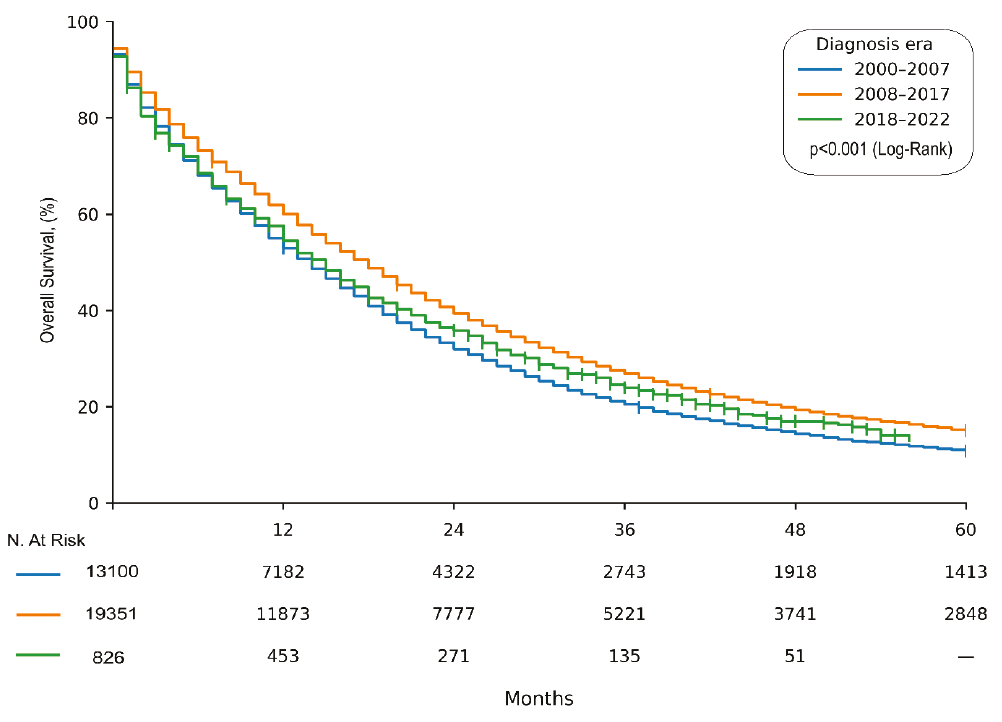
Kaplan-Meier curves depict observed overall survival stratified by diagnosis era (2000-2007, 2008-2017, and 2018-2022). Time is presented in months, measured from diagnosis to death or last follow-up. Numbers at risk are displayed below the X-axis. Differences between survival curves were assessed using the log-rank test.
Cox Proportional Hazards Analyses
In univariable analyses, older age (HR per year: 1.02; 95% CI: 1.01-1.03), absence of chemotherapy (HR: 2.44; 95% CI: 2.38-2.50), and absence of surgery to the primary tumor (HR: 2.08; 95% CI: 2.04-2.12) were associated with worse OS ().
In the multivariable Cox model adjusted for age, sex, chemotherapy, radiation therapy, and surgery of the primary tumor, a diagnosis in 2008-2017 was associated with improved OS compared with 2000-2007 (HR: 0.83; 95% CI: 0.81-0.85; p<0.001). Chemotherapy (HR: 0.49; 95% CI: 0.47-0.50) and surgery to the primary tumor (HR: 0.46; 95% CI: 0.45-0.47) were independently associated with OS ().
TABLE 3. Multivariable Cox proportional hazards analysis for overall survival.
Variable | HR | 95% CI | p-value |
|---|---|---|---|
Age (per 1 year) | 1.01 | 1.01-1.01 | <0.001 |
Female sex (vs. male) | 0.93 | 0.91-0.95 | <0.001 |
Chemotherapy (yes vs. no/unk) | 0.49 | 0.47-0.50 | <0.001 |
Radiation (yes vs. no/unk) | 0.83 | 0.81-0.85 | <0.001 |
Surgery to primary (any vs. none/unk) | 0.46 | 0.45-0.47 | <0.001 |
Era 2008-2017 (vs. 2000-2007) | 0.83 | 0.81-0.85 | <0.001 |
CI: Confidence interval; HR: Hazard ratio; hazard ratios were estimated using a multivariable Cox proportional hazards model adjusted for age, sex, chemotherapy, radiation therapy, surgery to the primary tumor, and diagnosis era. The reference categories were: male sex; no/unknown chemotherapy; no/unknown radiation therapy; no/unknown surgery to the primary tumor; and the diagnosis era 2000-2007.
Adjusted Survival, RMST, and Age-stratified Analyses
Standardized survival estimates derived from the multivariable Cox model showed an increase in adjusted OS across diagnostic eras. The RMST over 60 months was 20.9 months for patients diagnosed in 2000-2007, 23.8 months for those diagnosed in 2008-2017, and 24.7 months for those diagnosed in 2018-2022; this corresponds to an absolute difference of approximately 3.8 months between the earliest and most recent eras.
Age-stratified multivariable analyses demonstrated that the association between later diagnosis era and OS was generally consistent across age groups, with attenuated estimates among patients aged 80 years or older (). Formal testing for interaction showed no statistically significant interaction between age and diagnosis era (joint Wald test, p=0.313).
Sensitivity Analyses and Model Assumptions
In sensitivity analyses using an alternative calendar-time dichotomization (2000-2010 vs. 2011-2021), a diagnosis during 2011-2021 remained associated with improved OS (HR: 0.82; 95% CI: 0.79-0.85; p<0.001) ().
No material violations of the proportional hazards assumption were observed based on visual inspection of scaled Schoenfeld residuals for age and diagnosis era (). Model discrimination for explanatory analyses was stable (Harrell C-index: 0.69; optimism-corrected: 0.67).
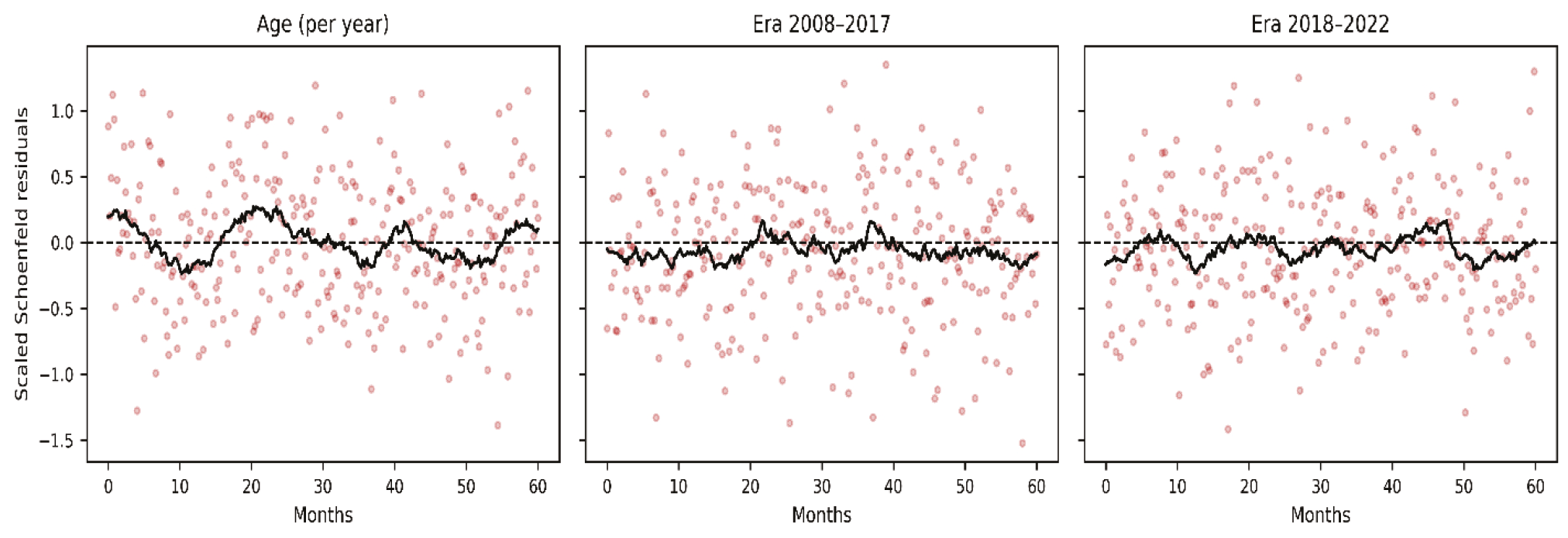
Scaled Schoenfeld residuals are shown for age (modeled as a continuous variable) and diagnosis era (2008-2017 and 2018-2022, with 2000-2007 as the reference category). The solid line represents a smoothed fit of the residuals over time, and the dashed horizontal line indicates zero. Visual inspection revealed no systematic time-dependent patterns, indicating no material violation of the proportional hazards assumption for the included covariates.
DISCUSSION
In this large, population-based analysis of patients with metastatic rectal and rectosigmoid cancer, we observed substantial temporal changes in OS across more than two decades. Analysis of SEER data from 2000 through 2022 showed that OS improved notably during the mid-diagnosis era (2008-2017) compared with the early era (2000-2007), with gains evident in both observed and adjusted survival metrics. These improvements were reflected not only in median OS but also in absolute survival measures, including RMST. In contrast, no statistically significant survival improvement was observed in the most recent era. Importantly, survival estimates for this period should be interpreted cautiously, given the limited follow-up duration and reduced statistical precision, which constrain definitive inference regarding long-term outcomes. Collectively, these findings provide contemporary population-level evidence that survival gains in metastatic rectal and rectosigmoid cancer have not occurred uniformly over time and underscore the importance of interpreting long-term outcomes within specific calendar eras.
A particularly notable observation is that survival gains were not linear across calendar time. While patients diagnosed in the mid-era experienced a clear improvement in OS compared with earlier cohorts, this advantage did not extend into the most recent period. Several factors may contribute to this apparent attenuation. Real-world adoption of newer systemic therapies often lags behind evidence generated in randomized clinical trials and may be influenced by patient fitness, comorbidity burden, and access to care—factors that are incompletely captured in trial populations and registry-based analyses., In parallel, contemporary cohorts increasingly include older and more clinically heterogeneous patients, including individuals with biologically aggressive disease who were underrepresented in earlier treatment eras or clinical trials., Although advances in combination chemotherapy, targeted agents, and biologic therapies have improved outcomes for selected patient subgroups, these benefits may not translate uniformly at the population level, particularly in rectal cancer, where treatment sequencing, local control strategies, and metastatic behavior differ from those of colon cancer.- The absence of a significant age-era interaction in our analyses further suggests that the observed attenuation of survival gains is unlikely to be explained solely by age-related treatment selection. Rather, these findings highlight the complexity of translating therapeutic innovation into sustained population-level benefit and reinforce the need to interpret survival trends within the context of real-world practice.-
Previous population-based and registry-based studies have generally reported improvements in survival among patients with metastatic CRC over time, attributing these gains to advances in systemic therapy and supportive care.- At the same time, an expanding literature has emphasized that survival benefits demonstrated in clinical trials are not always replicated to the same extent in routine clinical practice, reflecting differences in patient selection, treatment delivery, and health system-related factors., , Within this context, the present study provides a rectal cancer-specific, era-stratified assessment of OS in a large, unselected population-based cohort. The increasing incorporation of molecular stratification into treatment decision-making has led to meaningful survival improvements in selected subgroups; however, these benefits may be heterogeneously distributed at the population level. Survival advantages observed in carefully selected clinical trial populations may therefore be attenuated in real-world settings that increasingly include older patients, individuals with greater comorbidity burden, and those with biologically aggressive disease features., , , Viewed in this light, our findings align with prior population-level observations highlighting the gap between therapeutic efficacy and real-world effectiveness and underscore the importance of disease-specific and era-specific analyses when interpreting long-term survival trends in metastatic rectal and rectosigmoid cancer.-
From a clinical and population-level perspective, these findings suggest that improvements in OS cannot be assumed to occur uniformly over time, despite ongoing therapeutic advances. The attenuation of survival gains observed in the most recent era indicates that population-level outcomes may be shaped by a broader constellation of factors beyond the availability of new systemic therapies alone. These include patient vulnerability, treatment sequencing, multidisciplinary care integration, and health system-level constraints, which are not directly captured in registry data but may meaningfully influence real-world effectiveness., , , In metastatic rectal and rectosigmoid cancer—where treatment pathways and metastatic patterns differ from those of colon cancer—extrapolation from aggregated CRC cohorts may obscure clinically relevant heterogeneity. Taken together, these observations support cautious interpretation of survival trends and emphasize the value of contextual, era-specific evaluation when assessing temporal changes in population-based outcomes., ,
Study Limitations
This study has several strengths. The use of a large, population-based dataset provides substantial statistical power and enhances generalizability across real-world clinical settings. The extended study period enabled robust evaluation of temporal survival patterns across diagnostic eras, and the focus on rectal and rectosigmoid cancers addresses an important gap in prior CRC-wide analyses. Methodologically, the use of both observed and adjusted survival estimates, including RMST, together with formal assessment of proportional hazards assumptions, enhances the robustness of the findings. Several limitations should be acknowledged. The SEER database lacks detailed molecular, genomic, and inflammatory biomarkers, limiting adjustment for key biological factors that may influence prognosis and treatment selection. Treatment variables derived from SEER recode fields are subject to underreporting, and unknown treatment status is grouped with no treatment, potentially biasing associations toward the null. In addition, comorbidity burden, performance status, frailty, and socioeconomic factors are not systematically captured. Cause-specific mortality data were unavailable, precluding competing risk analyses. In addition, the follow-up duration for patients diagnosed in the most recent era (2018-2022) was limited, reducing statistical precision and constraining inferences regarding long-term survival patterns. Finally, given the retrospective, registry-based design, residual confounding cannot be fully excluded, and external validation in independent cohorts will be important to confirm generalizability.
CONCLUSION
In this population-based analysis of metastatic rectal and rectosigmoid cancers, OS improved during the mid-diagnosis era, but did not continue to increase in the most recent period. These findings indicate that survival gains have not occurred uniformly over time and highlight the importance of interpreting long-term outcomes within specific calendar eras and disease subtypes. Continued improvement in real-world outcomes may require attention to factors beyond therapeutic innovation alone, including patient heterogeneity and health system–level influences.
Footnotes
Ethics
Ethics Committee Approval: The study was approved by the institutional ethics committee (approval number: TABED 1-25-1885, date: 19.11.2025), and all procedures were conducted in accordance with Declaration of Helsinki and with strict adherence to patient confidentiality.
Informed Consent: Retrospective study.
Acknowledgments
The authors thank the SEER Program for providing access to the population-based cancer data used in this analysis. The authors also acknowledge colleagues from the Department of Medical Oncology at University of Health Sciences Türkiye, Ankara Etlik City Hospital for their general support and constructive discussions during the study design and interpretation phases. This study received no specific funding.
Authorship Contributions
Surgical and Medical Practices: Y.Ö.U., Concept: Y.Ö.U., Design: Y.Ö.U., O.A., M.Ü., F.K., Data Collection or Processing: Y.Ö.U., O.A., M.Ü., F.K., Analysis or Interpretation: A.E.K., A.B., M.Ş., Z.Ö.B., Literature Search: Y.Ö.U., A.E.K., M.Ş., Writing: Y.Ö.U., A.B., Z.Ö.B.
Conflict of Interest: No conflict of interest was declared by the authors.
Financial Disclosure: The authors declared that this study received no financial support.
References
Sung H, Ferlay J, Siegel RL, et al. Global Cancer Statistics 2020: GLOBOCAN estimates of incidence and mortality worldwide for 36 cancers in 185 countries. CA Cancer J Clin. 2021;71(3):209-249.
Dekker E, Tanis PJ, Vleugels JLA, Kasi PM, Wallace MB. Colorectal cancer. Lancet. 2019;394(10207):1467-1480.
Van Cutsem E, Cervantes A, Adam R, et al. ESMO consensus guidelines for the management of patients with metastatic colorectal cancer. Ann Oncol. 2016;27(8):1386-1422.
Cherri S, Oneda E, Zanotti L, Zaniboni A. Optimizing the first-line treatment for metastatic colorectal cancer. Front Oncol. 2023;13:1246716.
Zeineddine FA, Zeineddine MA, Yousef A, et al. Survival improvement for patients with metastatic colorectal cancer over twenty years. NPJ Precis Oncol. 2023;7(1):16.
Fenocchio E, Colombi F, Calella MG, et al. Improvement of metastatic colorectal cancer patient survival: single institution experience. Cancers (Basel). 2019;11(3):369.
Arnold D, Lueza B, Douillard JY, et al. Prognostic and predictive value of primary tumour side in patients with RAS wild-type metastatic colorectal cancer treated with chemotherapy and EGFR directed antibodies in six randomized trials. Ann Oncol. 2017;28(8):1713-1729.
Siebenhüner AR, Güller U, Warschkow R. Population-based SEER analysis of survival in colorectal cancer patients with or without resection of lung and liver metastases. BMC Cancer. 2020;20(1):246.
Aparicio T, Canouï-Poitrine F, Caillet P, et al. Treatment guidelines of metastatic colorectal cancer in older patients from the French Society of Geriatric Oncology (SoFOG). Dig Liver Dis. 2020;52(5):493-505.
Parakh S, Wong HL, Rai R, et al. Patterns of care and outcomes for elderly patients with metastatic colorectal cancer in Australia. J Geriatr Oncol. 2015;6(5):387-394.
van der Geest LG, Lam-Boer J, Koopman M, Verhoef C, Elferink MA, de Wilt JH. Nationwide trends in incidence, treatment and survival of colorectal cancer patients with synchronous metastases. Clin Exp Metastasis. 2015;32(5):457-465.
Mol L, Koopman M, van Gils CW, Ottevanger PB, Punt CJ. Comparison of treatment outcome in metastatic colorectal cancer patients included in a clinical trial versus daily practice in The Netherlands. Acta Oncol. 2013;52(5):950-955.
Booth CM, Tannock IF. Randomised controlled trials and population-based observational research: partners in the evolution of medical evidence. Br J Cancer. 2014;110(3):551-555.
Papamichael D, Audisio R, Horiot JC, et al; SIOG. Treatment of the elderly colorectal cancer patient: SIOG expert recommendations. Ann Oncol. 2009;20(1):5-16.
Hamers PAH, Elferink MAG, Stellato RK, et al. Informing metastatic colorectal cancer patients by quantifying multiple scenarios for survival time based on real-life data. Int J Cancer. 2021;148(2):296-306.
Pericay C, Fernández Montes A, Alonso Orduña V, et al. Real-world outcomes in patients with metastatic colorectal cancer in Spain: the RWD-ACROSS study. Cancers (Basel). 2023;15(18):4603.
Holleczek B, Rossi S, Domenic A, et al; EUROCARE-5 Working Group:. On-going improvement and persistent differences in the survival for patients with colon and rectum cancer across Europe 1999-2007 - Results from the EUROCARE-5 study. Eur J Cancer. 2015;51(15):2158-2168.
van Woerden V, de Graaff MR, Elfrink AKE, et al; Dutch Hepato Biliary Audit Group, Collaborators. Long-term outcome after liver surgery for colorectal metastases in elderly patients: a nationwide population-based study. HPB (Oxford). 2026;28(2):169-177.
Supplementary Materials
Supplementary Tables 1-3
Download