
Abstract
This current study sought to determine the prognostic ability of systemic immune-inflammation index (SII) in breast cancer (BC) patients. The predictive role of SII in pathologic complete response (pCR), of BC patients following neoadjuvant chemotherapy (NAC) was also investigated.This study adhered to the Preferred Reporting Items for Systematic reviews and Meta-Analyses guidelines. A systematic search was conducted in the Medline, ProQuest, Google Scholar, ScienceDirect, and the Cochrane Library databases, using search terms related to BC (population), high SII (exposure), low SII (control), and prognostic (outcome) to identify and update the systematic review and meta-analyses. Studies evaluating the prognostic outcomes of SII in BC were included. The prognostic outcomes included overall survival (OS), disease-free survival (DFS), distant metastasis-free survival (DMFS) and pCR. Review Manager 5.4 was used to perform meta-analysis. A total of 28 studies were included. Our study showed that a high SII was associated with worse OS [hazard ratio (HR)=1.88, 95% confidence interval (CI): 1.51-2.33, p-value<0.00001; I2=68%], DFS (HR=2.10, 95% CI: 1.60-2.75, p-value<0.00001; I2=77%), and DMFS (HR=1.89, 95% CI: 1.37-2.59, p-value<0.0001, I2=49%) in BC patients. Notably, SII was unlikely to predict pCR in BC patients following NAC (HR=0.90, 95% CI: 0.69-1.18, p-value=0.46, I2=71%).This updated systematic review and meta-analysis demonstrated that an elevated SII may be a potential predictor of poor OS, DFS, and DMFS in BC patients, but not a predictor of positive pCR. However, the findings are limited by different cut-off values, significant heterogeneity, and the observational nature of the included data.
Keywords: SII, systemic immune-inflammation index, breast cancer, survival, pathologic complete response
INTRODUCTION
Breast cancer (BC) is the most commonly diagnosed cancer in women worldwide, with 2.26 million new cases reported in 2020. It also stands as the top cause of cancer-related deaths in women. Over the past three decades, both the incidence and mortality rates of BC have risen.
Several biomarkers have been introduced for BC, including tumor-associated macrophages, MicroRNA, P53, circulating circular RNA, E-cadherin, Mib1, the Ki-67 antigen, human epidermal growth factor receptor 2 (HER2), and hormone-related biomarkers such as progesterone receptor and estrogen receptor. While some emerging biomarkers may still require complex and costly detection methods, many of these, such as estrogen receptor, progesterone receptor, HER2, and Ki-67, are already well-integrated into routine clinical practice due to their established diagnostic and prognostic value., The tumor microenvironment is significantly influenced by inflammation, with even minor alterations in inflammatory cell profiles having the potential to impact tumor development and progression, including the proliferation, invasion, migration, and metastasis of tumor cells. Recent clinical and epidemiological studies have shown that the inflammatory response is closely related to BC and could potentially be targeted for treatment or used as a prognostic indicator.
Peripheral blood examination offers advantages such as simplicity, convenience, high reproducibility, low cost, and better accessibility. Peripheral venous blood parameters, including platelet (P), monocyte (M), lymphocyte (L), neutrophil (N), and their derivatives such as the platelet-to-lymphocyte ratio (PLR), neutrophil-to-lymphocyte ratio (NLR), monocyte-to-lymphocyte ratio (MLR), lymphocyte-to-monocyte ratio (LMR), pan-immune inflammation value (PIV), and systemic immune-inflammation index (SII), have been identified as prognostic indicators in BC patients. The SII is a clinical biomarker that provides insight into the balance between inflammation and the immune response in cancer patients. It is calculated by taking the product of the N count and P count, and then dividing it by the L count. While the SII is linked to the prognosis of BC patients, the results remain controversial.
The most recent meta-analysis conducted by Cheng et al. in 2024 found that high SII was a significant predictor of overall survival (OS) [hazard ratio (HR): 1.97, 95% confidence interval (CI): 1.54-2.52, I²=76%] and disease-free survival (DFS) (HR: 2.07, 95% CI: 1.50-2.86, I²=79%) in BC patients. However, heterogeneity and the observational nature of the data were notable limitations of this review. To address these issues, we aim to update the findings by incorporating additional samples to obtain more homogeneous data, thereby providing more reliable outcomes. Furthermore, this study will investigate the predictive role of SII in the pathologic complete response (pCR) of BC patients following neoadjuvant chemotherapy (NAC). Through this, we aim to provide new insights and a more comprehensive understanding of the potential utilization of SII as a prognostic indicator for individuals with BC.
METHODS
The study was designed and conducted following the Preferred Reporting Items for Systematic Reviews and Meta-Analyses 2020 guidelines. The study protocol was registered in the International Prospective Register of Systematic Reviews on March 25th, 2025, under the registration number CRD420251019058.
Variable of Interest
This study aimed to provide an update of the existing systematic review and meta-analysis on the prognostic outcomes of SII in BC patients. We also investigate the predictive role of SII in pCR of BC patients after receiving NAC. pCR, classified as ypT0, ypTis, and ypN0, refers to the complete absence of invasive cancer cells in both the breast tissue and axillary lymph nodes following NAC.
Search Strategy
A comprehensive literature search was performed in March 2025 across electronic databases, including MEDLINE, Cochrane, Science Direct, ProQuest, and Google Scholar, to identify relevant studies. Two independent investigators conducted the search to maintain consistency and minimize bias, using the following search strategy to identify studies: “(Systemic immune inflammation index OR SII) AND (Breast cancer OR Breast Carcinoma OR Breast Tumor).” To maximize the retrieval of potentially relevant studies, backward searching (chain searching) was performed within the references of included studies.
Study Selection
Studies were selected for inclusion criteria based on following population, intervention or exposure, comparison, outcome, time, setting, study design strategy:
(1) Population: Patients diagH high SII;
(2) Intervention/Exposure: High SII;
(3) Comparison: low SII; The cut-off for high and low SII scores was not predefined, and all values used by the studies were acceptable
(4) Outcome: Cancer prognosis [e.g., OS, DFS, distant metastasis-free survival (DMFS); and pCR following NAC]
(5) Time: No restriction of time
(6) Setting: The study includes BC patients from different clinical settings, including tertiary care hospitals, oncology centers, and academic institutions.
(7) Study design: all studies examining SII and BC patient.
Articles were excluded if they met the following criteria: non-human studies, reviews, case reports, case series, book sections, editorials, or commentaries.
All retrieved studies were exported into the Zotero reference manager software for duplication-checking, followed by the screening of titles and abstracts. Two independent authors conducted the assessment, and studies were excluded if their titles or abstracts were deemed irrelevant. The selected studies then underwent full-text evaluation based on the predefined eligibility criteria. Corresponding authors of abstracts with insufficient data were contacted via email for further details; however, no responses were received. Any discrepancies were resolved through consensus among the review team.
Data Extraction
Two authors independently screened titles and abstracts to identify studies for inclusion in the systematic review. The selected studies underwent full-text screening based on the inclusion criteria, with reasons for exclusion documented. The reference lists of included studies were manually screened for additional relevant studies. Study selection was determined by majority agreement. Two authors independently extracted the following data: Primary author name, study design, country of origin, study period, sample size, age, molecular type, stage, treatment, median follow-up, cut-off value, cut-off determination, outcomes, and HR/odds ratio (OR) source (univariate or multivariate). Authors of the included studies were contacted for missing critical data when necessary.
Assessment of Risk of Bias
Each observational study was independently evaluated by two reviewers using the Newcastle-Ottawa scale (NOS). Interventional studies were assessed using the risk of bias 2 (ROB-2) tool for randomized trials.
Confidence in Cumulative Evidence
The confidence in cumulative evidence was determined using the Grades of Recommendation, Assessment, Development, and Evaluation (GRADE) approach. The GRADE system involves evaluating the quality of a body of evidence for each individual outcome. The quality of a body of evidence is determined by the ROB within a study (methodological quality), directness of evidence, heterogeneity, precision of effect estimates, and risk of publication bias. The overall certainty of the evidence was classified as high, moderate, low, or very low, quality.
Strategy for Data Synthesis
Data were synthesized using a random-effects model for all outcomes. Study heterogeneity was quantified using the I² statistic, with values below 25% indicating low heterogeneity, 25% to 50% representing moderate to substantial heterogeneity, and values above 50% indicating high heterogeneity. In cases of significant heterogeneity, potential sources were explored through sensitivity analyses. A p-value of less than 0.05 was considered statistically significant. Additionally, publication bias was assessed visually using a funnel plot, which plotted the effect size of each study against the inverse of its standard error. All statistical analyses were conducted using RevMan software, version 5.4.
RESULTS
Study Selection
The study selection process and findings were summarized in a flowchart (). Initially, 404 relevant studies were identified through the search strategy. After eliminating duplicates, 368 studies remained. This was followed by a title and abstract screening, which reduced the number to 45. Full-text screening of these 45 studies revealed 17 that did not meet the criteria: Five were reviews, three involved the wrong population, two had the wrong exposure, six featured the wrong outcome, and one lacked relevant data. Consequently, 28 studies were included in the updated systematic review and meta-analysis, with no unpublished studies meeting the criteria.
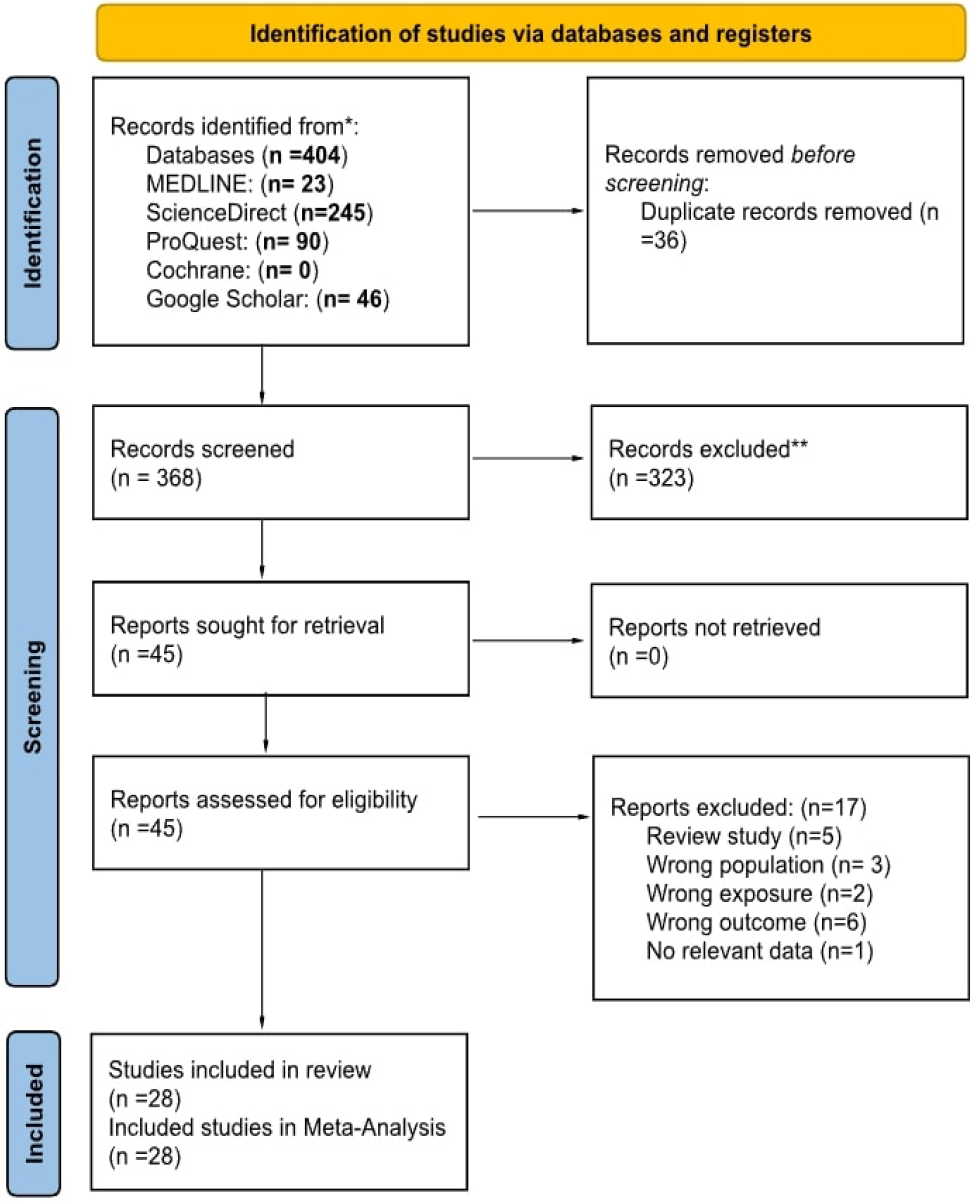
PRISMA: Preferred Reporting Items for Systematic Reviews and Meta-Analyses
Characteristics of the Included Studies
In total, 28 studies involving 17,291 patients with BC were included in this meta-analysis. Most studies were retrospective single-center cohorts, although one randomized phase II trial was also identified. The majority of studies were conducted in China, with others from Türkiye, Japan, Italy, France, and Brazil. Sample sizes ranged widely, from as few as 35 to nearly 2,000 patients, and the average patient age typically fell between 42 and 64 years. A broad spectrum of molecular subtypes was represented, including luminal A, luminal B (both HER2-negative and HER2-positive), HER2-enriched, triple-negative BC (TNBC), and hormone receptor-positive subtypes. Although some studies included patients with stage IV disease, most focused on early to locally advanced stages (I-III). Treatments varied across studies but commonly included surgery, neoadjuvant or adjuvant chemotherapy, radiotherapy, endocrine therapy, and targeted therapy. The SII was generally measured prior to surgery or systemic therapy, with cut-off values determined either by receiver operating characteristic (ROC) curve analysis or by using median values. Follow-up durations varied considerably, ranging from 3 to 73 months. Further detail in , .
TABLE 1. Study characteristics.
No | Author, year of publication | Study designs | Country and study period | Sample size | Age | Molecular type | Stage | Treatment | Median follow-up (months) | Cut-off | Cut-off determination | SII time of determination | Outcomes | HR/OR source | Quality |
|---|---|---|---|---|---|---|---|---|---|---|---|---|---|---|---|
1 | De Giorgi al.,14 2019 | Cohort retrospective | Italy, September 2004 - November 2009 | 516 | 59 | Triple-negative; HER2+; HER2-ER+ | IV | Chemotherapy, endocrine therapy, targeted therapy | 24 | 836 | ROC analysis | On the same day prior to starting a new systemic therapy, which was started at least 4 weeks after prior therapy and after full recovery of prior toxicities | OS | U | 8 (NOS) |
2 | Li et al.,15 2019 | Cohort retrospective | China, October 2008 - December 2013 | 161 | 58 | Luminal A; luminal B | I-III | Surgery (radical mastectomy), adjuvant chemotherapy and/ or radiotherapy, endocrine therapy | 28.4 | 518 | ROC analysis | Preoperative | DFS | M | 7 (NOS) |
3 | Liu et al.16, 2019 | Single center cohort retrospective | China, May 2000-June 2012 | 160 | N/A | Triple negative | I-III | Surgery (breast-conserving surgery and radical mastectomy), adjuvant and neoadjuvant chemotherapy, adjuvant radiotherapy | 61.7 | 557 | ROC analysis | Within the 7 days preceding surgery or neoadjuvant chemotherapy | OS, DFS | M | 6 (NOS) |
4 | Sun et al.,17 2019 | Single center cohort retrospective | China, September 2002-September 2012 | 155 | N/A | HR-, HER2+ | I-III | Surgery (breast-conserving surgery/radical mastectomy), neoadjuvant and adjuvant chemotherapy, postoperative radiotherapy, targeted therapy | 57.6 | 578 | Median value | 3 days before surgery or neoadjuvant chemotherapy | OS, DFS, DMFS | M | 6 (NOS) |
5 | Wang et al.,18 2019 | Single center cohort retrospective | China, November 2008-March 2016 | 215 | <50 : 155 (72%); - >50:60 (28%) | TNBC | I-III | Surgery (breast-conserving surgery/radical mastectomy), neoadjuvant and adjuvant chemotherapy, adjuvant radiotherapy | 49.2 | 624 | Median value | Prior to anticancer treatment | OS, DFS | M | 7 (NOS) |
6 | Shi et al.,19 2019 | Single center cohort retrospective | China, March 2008-June 2014 | 379 | 49 | TNBC | I-III | Surgery, postoperative adjuvant therapy | 71 | 500 | N/A | preoperative | DFS, OS | U | 9 (NOS) |
7 | Chen et al.,20 2020 | Single center cohort retrospective | China, January 1999-December 2014 | 262 | 48 | Luminal A; luminal B HER2+; luminal B HER2-; HER2 enriched; triple negative | II-III | Surgery, neoadjuvant chemotherapy, post-operative radiotherapy, post-operative endocrine therapy, post-operative targeted therapy | 48 | 602 | ROC analysis | 1 week after BC diagnosis and before neoadjuvant chemotherapy | OS, DFS, pCR | M | 7 (NOS) |
8 | Hua et al.,21 2020 | Single center cohort retrospective | China, December 2010-January 2012 | 1026 | 47 | Luminal A; luminal B/HER2-; luminal B/HER2+; triple negative | I-III | Surgery (breast conserving surgery/mastectomy), adjuvant chemotherapy, endocrine therapy, radiotherapy, targeted therapy | 68.5 | 601.7 | ROC analysis | Within 3 days of the time of surgery | OS, DMFS | M | 7 (NOS) |
9 | Jiang et al.,22 2020 | Single center cohort retrospective | China, April 2011-September 2015 | 147 | <35: 7; (4.8%) >35: 140 (95.2%) | HER2+ | I-III | Surgery (breast conserving surgery/mastectomy), adjuvant chemotherapy, adjuvant endocrine therapy, adjuvant radiotherapy, adjuvant targeted therapy | 42 | 442 | ROC analysis | Within 3 days preceding surgery | OS, DFS, | M | 7 (NOS) |
10 | Jiang et al.,23 2020 | Single center cohort retrospective | China, January 2014-May 2018 | 249 | <51: 134 (53.8%) - - >51: 115 (46.2%) | Luminal A; Luminal B/HER2-; Luminal B/HER2+; Triple negative; HER2 enriched | I-III | Neoadjuvant chemotherapy | 28-34 | 547 | ROC analysis | One week prior to neoadjuvant chemotherapy | OS, pCR | M | 8 (NOS) |
11 | Pang et al.,24 2021 | Single center cohort retrospective | China, January 2015-June 2019 | 231 | <49 : 115 (49.7%) >49:116 (50.3%) | TNBC | I-III | Surgery neoadjuvant chemotherapy | 36 | 474 | Median value | 1 week before chemotherapy | DFS, pCR | M | 7 (NOS) |
12 | Li et al.,25 2021 | Single center cohort retrospective | China, June 2012-July 2015 | 784 | 49 | Luminal A; Luminal B; HER2 enriched; triple negative | I-III | Surgery | 65.5 | 514 | ROC analysis | 1 weeks before surgery | OS, DFS | M | 8 (NOS) |
13 | Celik et al.,26 2021 | Single center cohort retrospective | Turkey, January 2013-May 2020 | 80 | 58±12.1 | HR+ HER2- | IV | Neoadjuvant/ adjuvant chemotherapy, targeted therapy, endocrine therapy | 8.9 | 535 | ROC analysis | 1-7 days prior to initiating Everolimus plus exemestane treatment | PFS | U | 6 (NOS) |
14 | Zhu et al.,3 2022 | Single center cohort retrospective | China, January 1998-December 2016 | 785 | 47 | Luminal A; luminal B/HER2-; luminal B/HER2+; HER-2 enriched; triple negative | I-III | Surgery (breast-conserving surgery/ mastectomy), neoadjuvant chemotherapy, postoperative chemotherapy, postoperative radiotherapy, postoperative endocrine therapy, postoperative targeted therapy | N/A | 560 | ROC analysis | N/A | OS, DFS | M | 7 (NOS) |
15 | Xu et al.,27 2022 | Single center cohort retrospective | China, February 2013-May 2020 | 508 | 49 | Mixed | I-IV | Surgery (breast-conserving surgery/modified radical mastectomy/total mastectomy) | N/A | 429.4 | N/A | 1 weeks before surgery | OS, DFS | M | 7 (NOS) |
16 | Tang et al.,28 2022 | Single center cohort retrospective | China, January 2011-February 2013 | 97 | 46 | Luminal A; lumunial B; HER2+; TNBC | II-III | Surgery (radical mastectomy), chemotherapy | 62.5 | 610.79 | ROC analysis | N/A | OS | M | 8 (NOS) |
17 | To et al.,29 2023 | Single center randomized phase II clinical trial design | France, October 2016-September 2021 | 42 | NACT 48 | Luminal B; triple-negative | I-III | Surgery, neoadjuvant chemoteraphy; neoadjuvant chemo-radiotherapy | N/A | 252 | ROC analysis | (1) 1 week before any neoadjuvant treatment; (2) within 2 weeks before APBI delivery in the NACRT group, or 2 months after the initiation of NACT in the NACT group, (3) within 2 weeks after APBI delivery in the NACTY group, or 3 months after the initiation of NACT in the NACT group, (4) after NAT, collected within 3 weeks after the last cycle of NACT in both groups | pCR | U | Low (ROB2) |
18 | Yamanouchi et al.,30 2023 | Single center cohort retrospective | Japan, April 2008-July 2020 | 46 | 57 | Luminal; HER2: triple-negative | IV | Surgery, systemic therapy according to the surrogate subtype | 30 | 829 | Median value | Within 4 weeks before systemic therapy | OS | M | 7 (NOS) |
19 | Yamanouchi et al.,31 2023 | Single center cohort retrospective | Japan, January 2012-December 2021 | 35 | 64 | Luminal; HER2: triple-negative | IV | Systemic therapy (chemotherapy) | 15 | 672 | Median value | Within 4 weeks before systemic therapy | OS | U | 7 (NOS) |
20 | Zhou et al.,32 2023 | Single center cohort retrospective | China, June 2010-October 2020 | 1489 | 51 | HR+HER2-; TNBC; HR-HER2+; HR+HER2+ | 0-IV | Surgery, neoadjuvant chemotherapy plus single/dual ERBB2-targeted therapy neoadjuvant therapy | 3-6 | 475 | Median value | Before any treatment modality was initiated | pCR | M | 8 (NOS) |
21 | Ma et al.,33 2023 | Single center cohort retrospective | China, January 2019-June 2022 | 112 | 44.5 50.94±8.43 | Luminal A; luminal B (HER2-); luminal B (HER2+); HER2+; triple negative | I-IV | Surgery, neoadjuvant chemotherapy (NAC) | N/A | 598.5 | ROC analysis | Before neoadjuvant chemotherapy | pCR | U | 8 (NOS) |
22 | Pang et al.,34 2024 | Single center cohort retrospective | China, July 2013-March 2018 | 544 | N/A | HER2+ | I-III | Surgery (breast conserving surgery/modified radical mastectomy), postoperative chemotherapy, postoperative radiotherapy, postoperative endocrine therapy, targeted therapy | 49.5 | 430 | Median value | Obtained at the patient’s initial hospital admission, without clinical signs of fever or infection | DFS | M | 9 (NOS) |
23 | Chen et al.,35 2024 | Single center cohort retrospective | China, January 2012-December 2017 | 152 | N/A | Mixed | I-III | Surgery, postoperative adjuvant therapy | N/A | 741 | ROC analysis | N/A | DFS | M | 8 (NOS) |
24 | Yildirim et al.,36 2024 | Single center cohort retrospective | Turkey, January 2010-November 2022 | 624 | 50 | Hormon positive and HER2 negative; HER2 positive; triple negative | I-III | Neoadjuvant chemotherapy | 42 | 639.66 | ROC analysis | Before starting Neoadjuvant chemotherapy | OS, PFS | M | 8 (NOS) |
25 | Faria et al.,37 2024 | Single center cohort retrospective | Brazil, January 2008-December 2013 | 710 | 60 | Luminal A + luminal B; HER2; TNBC, luminal hybrid | I-III | Surgery (quadranetcomy/mastectomy) chemotherapy, radiotherapy, endocrine therapy | 73 | 250 | Median value | Taken before systemic therapy/radiotherapy | DFS | U | 8 (NOS) |
26 | Karhan et al.,38 2024 | Multicenter cohort retrospective | Turkey | 102 | 42 | TNBC | I-III | Neoadjuvant chemotherapy | N/A | 643 | Median value | 3 weeks prior to neoadjuvant chemotherapy | pCR, OS | N/A | 6 (NOS) |
27 | Wang et al.,39 2024 | Single center cohort retrospective | China, June 2013-July 2022 | 1994 | 50 | Luminal A; luminal B; HER2; triple negative | I-III | Neoadjuvant chemotherapy, adjuvant radiotherapy, targeted therapy, | N/A | 600.31 | ROC analysis | 2 weeks prior to the initiation of NAT and 2-3 weeks after the NAT completion | pCR | U | 9 (NOS) |
28 | Liu et al.,40 2025 | Single center cohort retrospective | China, June 2012-June 2016 | 480 | 50 | HR+HER2– | I-IV | Surgery, neoadjuvant/adjuvant chemotherapy, postsurgical radiotherapy, endocrine therapy | 37 | N/A | Median value | 1 week before any chemotherapy or surgical procedure | DFS | M | 9 (NOS) |
NAC: Neoadjuvant chemotherapy; pCR: Pathologic complete response; M: Multivariate; U: Univariate. In “HR/OR Source” column: “U” indicates HR or OR derived from a univariate model (unadjusted); “M” indicates HR/OR derived from a multivariate model (adjusted for potential confounding factors). HR: Hazard ratio; OR: Odds ratio; NOS: Newcastle-Ottawa scale; OS: Overall survival; DFS: Disease-free survival; DMFS: Distant metastasis-free survival; HER2: Human epidermal growth factor receptor 2; ROC: Receiver operating characteristic; TNBC: Triple-negative breast cancer; PFS: Progression-free survival.
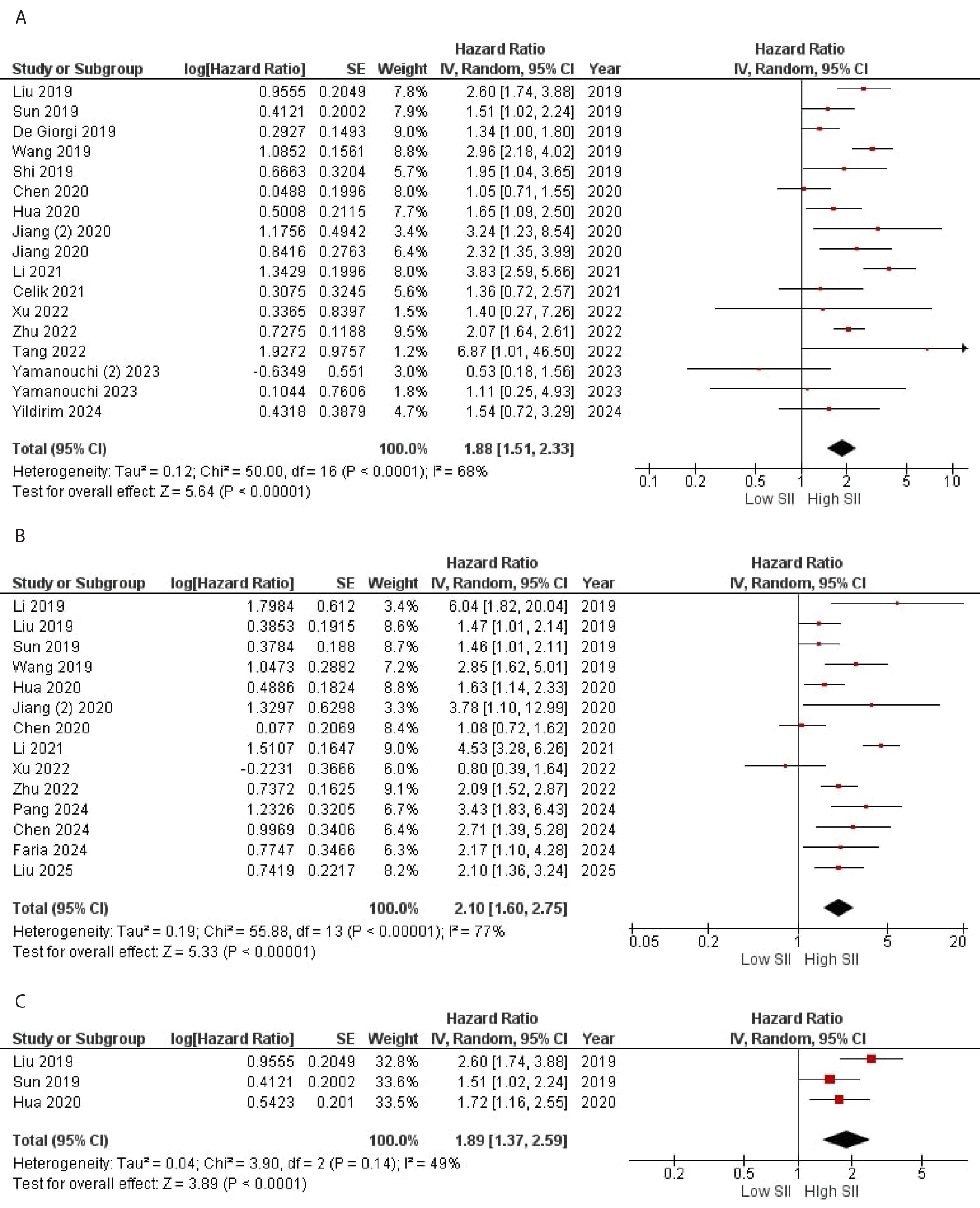
SII: Systemic immune-inflammation index; CI: Confidence interval
Meta-analysis Results
The quantitative meta-analysis of 17 studies, identified a high SII as a significant predictor of OS in BC patients (HR=1.88, 95% CI: 1.51-2.33, p<0.00001), although substantial heterogeneity was observed (I²=68%). Similarly, analysis of 14 studies revealed that elevated SII was associated with poorer DFS (HR=2.10, 95% CI: 1.60-2.75, p<0.00001) with considerable heterogeneity (I²=77%). For DMFS, findings from 3 studies indicated a significant association between high SII and DMFS (HR=1.89, 95% CI: 1.37-2.59, p<0.0001), though with moderate heterogeneity (I²=49%). In contrast, pooled data from 8 studies showed that SII was not a significant predictor of pCR in BC patients undergoing NAC (OR=0.91, 95% CI: 0.70-1.19, p=0.51), although heterogeneity remained high (I²=67%).
Subgroup analyses based on BC molecular type, treatment, SII cut off value, cut off determination, BC stage, study design, and HR/OR source have been conducted as presented in , . In the context of OS, high SII was most strongly linked to poor prognosis among patients with TNBC, with a pooled HR of 2.69 (95% CI: 2.14-3.37) and no observed heterogeneity (I²=0%), indicating a consistent and reliable association across studies. This finding highlights the particularly strong influence of systemic inflammation in this aggressive and immunologically distinct subtype. In comparison, patients with HER2-positive BC also showed a significant, though more moderate, increased risk associated with high SII (HR=1.79; 95% CI: 1.19-2.71). Meanwhile, data specific to luminal subtypes were insufficient to draw meaningful conclusions. The mixed-subtype group showed a significant association as well (HR=1.69, 95% CI: 1.26-2.27), but with substantial heterogeneity (I²=70%), suggesting the influence of diverse tumor biology and treatment approaches within this category.
TABLE 2. Subgroup analysis.
Variable | Groups | Number of studies | HR/OR (95% CI) | p-value | I2 (p-value) |
|---|---|---|---|---|---|
Overall survival | - | - | - | - | |
BC molecular type | HER2+ | 2 | 1.79 (1.19, 2.71) | 0.005 | 37% (0.21) |
Luminal | 0 | Not applicable | |||
TNBC | 3 | 2.69 (2.14, 3.37) | <0.00001 | 0% (0.49) | |
Mixed | 12 | 1.69 (1.26, 2.27) | 0.0005 | 70% (0.0001) | |
Treatment | Surgery | 2 | 3.22 (1.53, 6.78) | 0.002 | 26% (0.24) |
Non-surgery | 5 | 1.39 (0.97, 2.00) | 0.07 | 35% (0.19) | |
Mixed | 10 | 1.95 (1.54, 2.46) | <0.00001 | 62% (0.005) | |
Cut-off value | <550 | 6 | 2.36 (1.63, 3.44) | <0.00001 | 47% (0.09) |
>550 | 11 | 1.70 (1.32, 2.20) | <0.0001 | 71% (0.0002) | |
Cut-off determination | Median value | 4 | 1.52 (0.78, 2.92) | 0.22 | 79% (0.002) |
ROC analysis | 11 | 1.95 (1.50, 2.53) | <0.00001 | 71% (0.0001) | |
NR | 2 | 1.87 (1.04, 3.36) | 0.04 | 0% (0.71) | |
Study design | Cohort study | 17 | 1.88 (1.51, 2.33) | <0.00001 | 68% (<0.0001) |
RCT | 0 | Not applicable | |||
Stage | I-III | 12 | 2.12 (1.68, 2.68) | <0.00001 | 68% (0.0003) |
IV | 4 | 1.27 (0.98, 1.64) | 0.07 | 0% (0.44) | |
I-IV | 1 | 1.40 (0.27, 7.26) | 0.69 | Not applicable | |
HR source | Multivariate | 13 | 2.12 (1.88, 2.40) | <0.00001 | 66% (0.0005) |
Univariate | 4 | 1.35 (1.07, 1.72) | 0.01 | 28% (0.24) | |
Disease free survival | |||||
BC molecular type | HER2+ | 2 | 2.15 (0.93, 4.95) | 0.07 | 81% (0.02) |
Luminal | 2 | 3.05 (1.13, 8.22) | 0.03 | 62% (0.10) | |
TNBC | 2 | 1.98 (1.04, 3.77) | 0.04 | 73% (0.06) | |
Mixed | 8 | 1.99 (1.31, 3.04) | 0.001 | 83% (<0.00001) | |
Treatment | Surgery | 2 | 1.96 (0.36, 10.73) | 0.44 | 95% (<0.0001) |
Non-surgery | 1 | 3.78 (1.10, 12.99) | 0.03 | Not applicable | |
Mixed | 11 | 1.94 (1.56, 2.40) | <0.00001 | 55% (0.01) | |
Cut-off value | <550 | 6 | 2.81 (1.57, 5.03) | 0.0005 | 76% (0.0008) |
>550 | 7 | 1.71 (1.36, 2.15) | <0.00001 | 53% (0.05) | |
NR | 1 | 2.10 (1.36, 3.24) | 0.0008 | Not applicable | |
Cut-off determination | Median value | 5 | 2.18 (1.60, 2.96) | <0.00001 | 44% (0.13) |
ROC analysis | 8 | 2.25 (1.50, 3.37) | <0.0001 | 83% (<0.00001) | |
NR | 1 | 0.80 (0.39, 1.64) | 0.54 | Not applicable | |
Study design | Cohort | 14 | 2.10 (1.60, 2.75) | <0.00001 | 77% (<0.00001) |
RCT | 0 | Not applicable | |||
Stage | I-III | 12 | 2.10 (1.85, 2.39) | <0.00001 | 78% (<0.00001) |
IV | 0 | Not applicable | |||
I-IV | 2 | 1.62 (1.12, 2.35) | 0.01 | 80% (0.02) | |
HR source | Multivariate | 12 | 2.02 (1.78, 2.28) | <0.00001 | 79% (<0.00001) |
Univariate | 2 | 2.78 (1.54, 5.02) | 0.0007 | 53% (0.15) | |
Distant metastasis free survival | - | - | |||
BC type | HER2+ | 1 | 1.51 (1.02,2.24) | 0.04 | Not applicable |
TNBC | 1 | 2.60 (1.74, 3.88) | <0.0001 | Not applicable | |
Luminal | 0 | Not applicable | |||
Mixed | 1 | 1.72 (1.16, 2.55) | 0.007 | Not applicable | |
Treatment | Surgery | 0 | Not applicable | ||
Non-surgery | 0 | Not applicable | |||
Mixed | 3 | 1.89 (1.37, 2.59) | <0.0001 | 49% (0.14) | |
Cut-off value | <550 | 0 | Not applicable | ||
>550 | 3 | 1.89 (1.37, 2.59) | <0.0001 | 49% (0.14) | |
Cut-off determination | Median value | 1 | 1.51 (1.02, 2.24) | 0.04 | Not applicable |
ROC analysis | 2 | 2.11 (1.41, 3.16) | 0.0003 | 52% (0.15) | |
Study design | Cohort study | 3 | 1.89 (1.37, 2.59) | <0.0001 | 49% (0.14) |
RCT | 0 | Not applicable | |||
Stage | I-III | 3 | 1.89 (1.37, 2.59) | <0.0001 | 49% (0.14) |
IV | 0 | Not applicable | |||
I-IV | 0 | Not applicable | |||
HR source | Multivariate | 3 | 1.89 (1.37, 2.59) | <0.0001 | 49% (0.14) |
Univariate | 0 | Not applicable | |||
Pathologic complete response | |||||
BC type | HER2 | 1 | 1.58 (0.81, 3.08) | 0.18 | Not applicable |
TNBC | 1 | 0.35 (0.14, 0.88) | 0.02 | Not applicable | |
Mixed | 7 | 0.92 (0.70, 1.21) | 0.56 | 70% (0.005) | |
Treatment | Surgery | 0 | Not applicable | ||
Non-surgery | 3 | 1.18 (0.92, 1.52) | 0.19 | 15% (0.31) | |
Mixed | 5 | 0.64 (0.34, 1.17) | 0.15 | 78% (0.001) | |
Cut-off value | <550 | 4 | 0.91 (0.55, 1.51) | 0.71 | 57% (0.07) |
>550 | 4 | 0.79 (0.43, 1.44) | 0.45 | 82% (0.0009) | |
Cut-off determination | Median value | 2 | 0.66 (0.24, 1.80) | 0.41 | 80% (0.02) |
ROC analysis | 6 | 0.90 (0.56, 1.44) | 0.67 | 72% (0.003) | |
Study design | Cohort study | 7 | 0.90 (0.68, 1.19) | 0.47 | 75% (0.0006) |
RCT | 1 | 0.75 (0.12, 4.69) | 0.76 | Not applicable | |
Stage | I-III | 6 | 1.03 (0.73, 1.44) | 0.88 | 46% (0.10) |
IV | 0 | Not applicable | |||
0-IV | 2 | 0.52 (0.13, 2.09) | 0.35 | 92% (0.0003) | |
OR source | Multivariate | 5 | 0.97 (0.72, 1.31) | 0.85 | 48% (0.10) |
Univariate | 3 | 0.61 (0.17, 2.15) | 0.44 | 87% (0.0004) | |
OR: Odds ratio; HR: Hazard ratio; HER2: Human epidermal growth factor receptor 2; ROC: Receiver operating characteristic; TNBC: Triple-negative breast cancer; BC: Breast cancer; CI: Confidence interval; RCT: Randomized controlled trial.
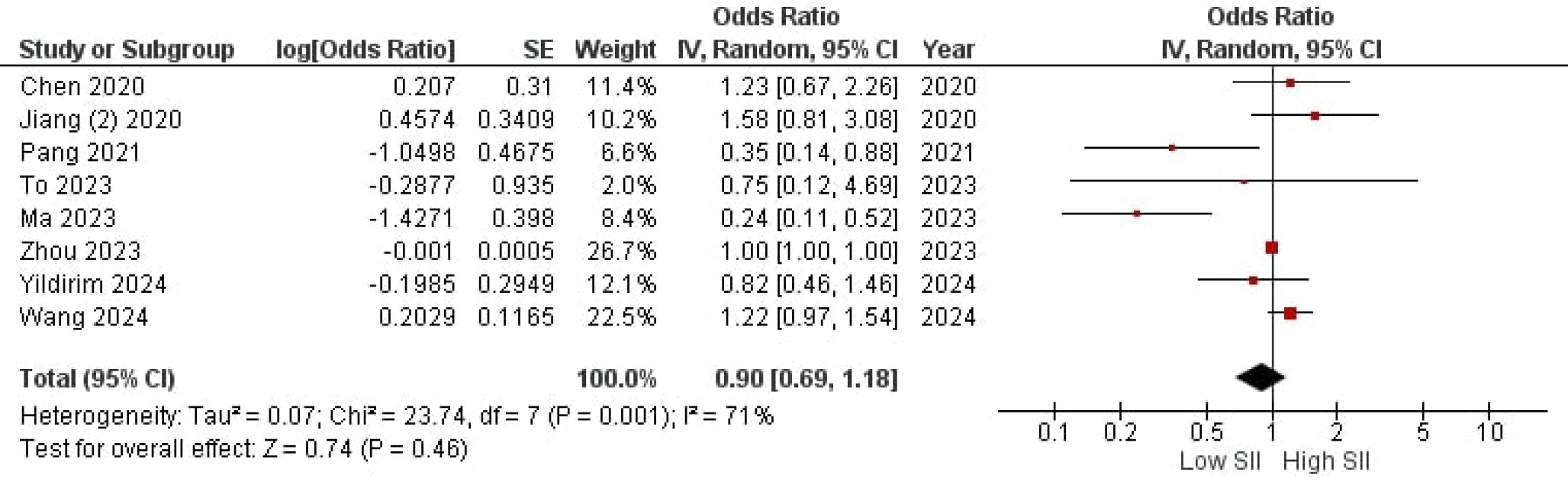
SII: Systemic immune-inflammation index; CI: Confidence interval
A similar pattern was observed for DFS, where TNBC again demonstrated a significant association with high SII (HR=1.98; 95% CI: 1.04-3.77), reinforcing the potential of SII as a prognostic marker, particularly in more biologically aggressive forms of BC. Interestingly, when examining pCR, high SII was associated with a significantly lower likelihood of achieving it in TNBC (OR: 0.35; 95% CI: 0.14-0.88; p=0.02). This inverse relationship may reflect the role of systemic inflammation in dampening treatment response, potentially through mechanisms such as immune suppression or a less favorable tumor microenvironment, which could compromise the effectiveness of NAC in this challenging subtype.
Quality Assessment and Confidence in Cumulative Evidence
There was a low to moderate ROB among the 28 studies that were assessed using NOS and ROB-2 (). A moderate quality of evidence was determined by using the GRADE approach to create an evidence profile, as shown in .
TABLE 3. Grade evidence profile.
Outcome | Number of studies | Quality assessment | Summary findings | ||||||
|---|---|---|---|---|---|---|---|---|---|
NOS | Inconsistency | Indirectness | Imprecision | Publication bias | Overall quality of evidence | HR total | 95% CI (lower, upper) | ||
OS | 17 | Not serious | Seriousa | Not serious | Not serious | Not seriousc | Moderate | 1.88 | 1.51, 2.33 |
DFS | 14 | Not serious | Seriousa | Not serious | Not serious | Not seriousc | Moderate | 2.10 | 1.60, 2.75 |
DMFS | 3 | Not serious | Not serious | Not serious | Seriousb | Not seriousc | Moderate | 1.89 | 1.37, 2.59 |
pCR | 8 | Not serious | Seriousa | Not serious | Not serious | Not seriousc | Moderate | 0.90 | 0.69, 1.18 |
a: The data show contradictory findings since some research favor other groups.
b: Only a few studies (no more than five studies per outcome) provide effect estimates.
c: Publication bias was evaluated qualitatively. HR: Hazard ratio; CI: Confidence interval; NOS: Newcastle-Ottawa scale; DFS: Disease-free survival; DMFS: Distant metastasis-free survival; OS: Overall survival; pCR: Pathologic complete response.
Publication Bias and Sensitivity Analyses
The sensitivity analysis was conducted and demonstrated that the pooled results were not affected after the removal of any single study. Funnel plot analysis as presented in indicated potential publication bias for OS and pCR, with some asymmetry suggesting selective reporting or heterogeneity. A mild asymmetry was observed for DFS, while no clear bias was evident for DMFS, though the small number of studies limits interpretation.
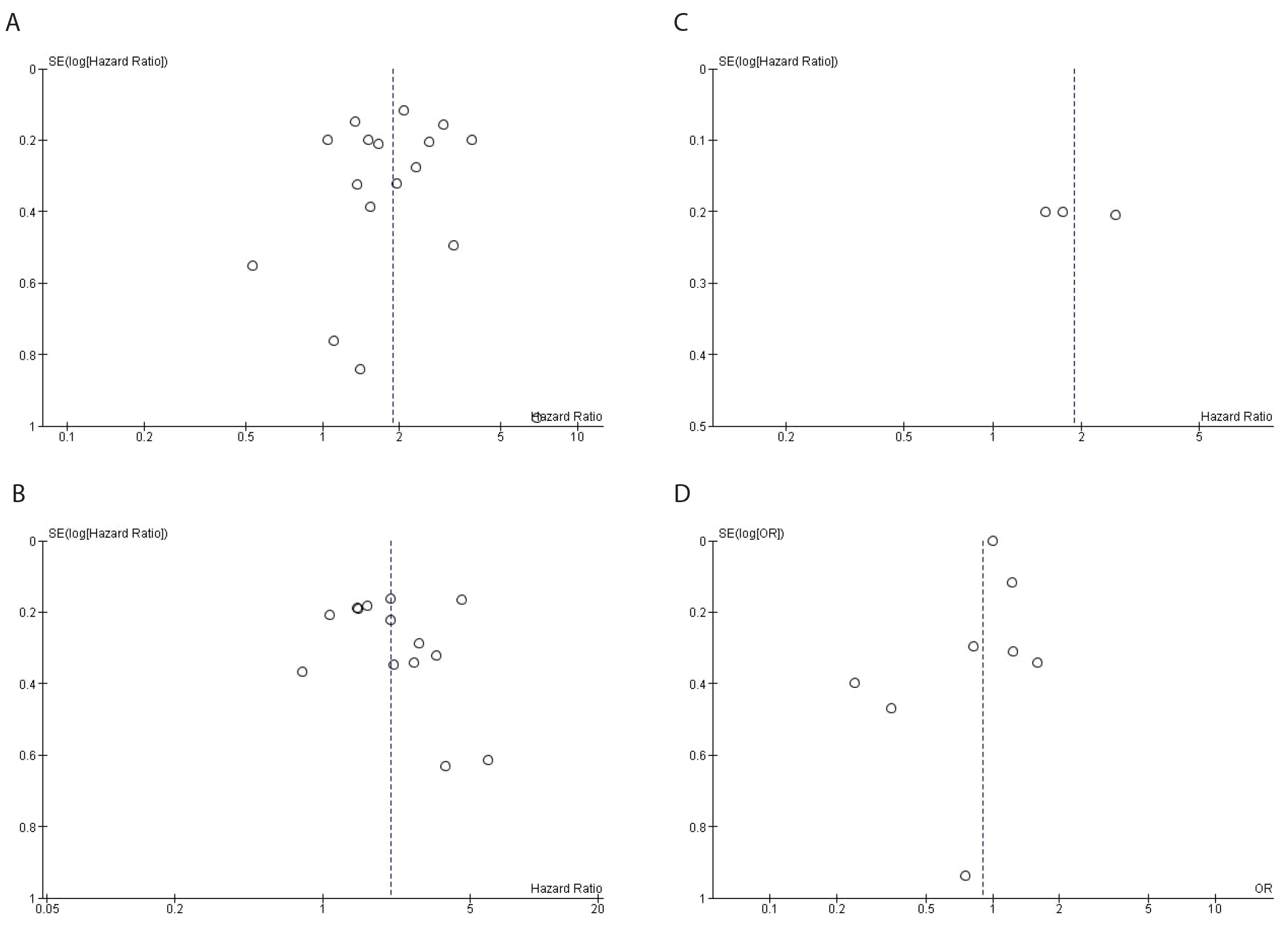
OS: Overall survival; DFS: Disease-free survival; DMFS: Distant metastasis-free survival; pCR: Pathologic complete response
DISCUSSION
The prognostic framework of BC has progressively evolving inflammation-based indicators, with the SII emerging as a promising biomarker for predicting patient outcomes. Standard clinical and pathological criteria have historically been used to evaluate the prognosis of BC; however, several studies have shown promise in the addition of SII response markers., The SII is a quantitative marker calculated using peripheral blood cell counts. The widely accepted equation is SII=(N count × P count)/L count. SII illustrates the dual function of inflammation in cancer, as increased N and P levels may signify pro-tumor inflammatory mechanisms, whereas a reduced L count may indicate an impaired anti-tumor immune response. The SII has multiple clinical benefits, especially in cancer patients. This index serves as a multifaceted tool that evaluates inflammatory status and can predict treatment responses and patient outcomes across various malignancies.
Various clinical studies highlighted the practical advantages offered by SII. Compared to other inflammation-based parameters (NLR, PLR, LMR, MLR, PIV), the SII showed independent prognostic value across diverse BC subtypes and treatment protocols. For instance, Zhu et al. and Yang et al. have shown that a lower SII correlates with improved DFS and OS, suggesting that SII may have superior predictive accuracy in stratifying high- versus low-risk patients. The SII is convenient to perform because it requires only a standard complete blood count and is cost-effective relative to other modalities. Recent studies highlight the role of the SII in predicting outcomes of immunotherapies and where elevated inflammatory markers often correlate with poorer prognoses in various cancer types, including BC. Zhou et al. suggest that cytokine-induced killer cell-based immunotherapy can reduce tumor recurrence and prolong survival in postoperative BC patients, indicating a positive association between immune response activation and clinical outcomes. Current advancements in the understanding of BC immunogenicity pave the way for innovative approaches. For instance, PD-L1 expression has emerged as a predictive biomarker for response to immune checkpoint inhibitors like avelumab and pembrolizumab, particularly in triple-negative BC (TNBC). A compelling aspect of current clinical trials is the synergistic approach of combining chemotherapy with immunotherapy. For example, studies of the NAC regimen combined with immune checkpoint blockade show promise in inducing pCR, linking inflammation-induced immune activation with improved outcomes in high-risk early-stage BC.,
Our findings show that BC patients with a high SII experience significant worse prognostic outcome. Elevated SII was associated with a lower OS, an increased risk of disease recurrence, and a greater probability of distant metastasis. Based on our current meta-analysis results, SII can indicate an immunosuppressive tumor microenvironment and more aggressive tumor behavior, subsequently leading to poor long-term outcomes. Increased P and N counts combined with decreased lymphocyte counts indicate an imbalance in the host immune response, which is reflected in elevated SII. Neutrophils play a significant role in protumorigenic processes by releasing pro-inflammatory cytokines (interleukin-1 beta, tumor necrosis factor-alpha, and transforming growth factor-beta) and growth factors including vascular endothelial growth factor and fibroblast growth factors, which enhance tumor cell proliferation and invasion., Simultaneously, platelets are recognized to protect circulating tumor cells from immune recognition and assist in their adhesion to the endothelium, thus promoting metastasis. In contrast, lower lymphocyte counts are indicative of weakened cell-mediated immune surveillance, meaning that the natural tumor-suppressing effects of lymphocytes are compromised. Collectively, this milieu favors tumor aggressiveness and facilitates both locoregional recurrence (affecting DFS) and the spread of cancer to distant organs (impacting DMFS).
Previous meta-analyses conducted by various authors have similarly resulted in findings that are consistent with our meta-analysis, demonstrating that an increased SII correlates with poorer OS, DFS, and DMFS., , , In contrast to previous studies, in our study we evaluated pCR, which has never been done. This PCR is very important in determining whether a patient is truly free from cancer. pCR, characterized by the absence of both invasive and in situ residuals in breast tissue and lymph nodes, serves as a reliable discriminator between patients with favorable and unfavorable outcomes.
Notably, although SII was unlikely to predict pCR in BC patients undergoing NAC, SII may predict survival but not short-term treatment response. These results indicate inconsistency, especially in several supporting studies in this meta-analysis, which show that dietary SII can be used as a predictive factor for SII., , , , However, not all of the studies we used in this review showed significant results, especially regarding the use of SII as a predictor of pCR., Arici et al. compared several blood-derived inflammatory markers in BC patients undergoing NAC and demonstrated that the PIV value provided a superior predictive ability for pCR over SII. Their results indicate that SII is inadequate as an independent predictor of pCR in this setting. The study suggested that SII’s limited performance might be related to its inability to encapsulate the complexity of the immune microenvironment and tumor biology, which are pivotal in mediating response to chemotherapy. Yildirim et al. found that SII was still inconsistent in showing an effect on pCR as a predictive value, similar to other indices like PLR, PNI, HALP, and HRR. However, this study showed that only NLR can be used as a predictive value for pCR after undergoing NAC. Supporting this notion, Ciurescu et al. evaluated the prognostic value of SII, in a retrospective cohort of BC patients and found that, despite its utility in risk stratification and long-term outcome prediction, the current evidence does not substantiate its use as a predictive tool for NAC response, including pCR. The authors cautioned that although SII can guide prognosis, its role in influencing immediate treatment decisions remains indeterminate based on available data. In this study, the results are very visible moderate to high in the heterogeneity of this study, especially OS (I2=72.0%, p<0.00001), DFS (I2=77.0%, p<0.00001), DMFS (I2=49.0%, p<0.0001) and PCR (I2=71.0%, p<0.001). The cut-off value of ROC analysis ranged from 252 to 836, while the median value ranged from 250 to 829. To explore the underlying sources, we performed detailed subgroup analyses. For OS, heterogeneity was notably reduced in certain subgroups, particularly in TNBC, where the I² dropped to 0%. Similar improvements were seen in patients undergoing surgery or with stage IV disease, suggesting that tumor subtype, treatment type, and disease stage all play a role in explaining differences across studies. We also observed that statistical methods mattered, as studies using univariate analyses showed lower heterogeneity than those using multivariate models.
For DFS, although heterogeneity remained high overall, it was somewhat reduced when studies were grouped based on how the SII cut-off was determined. Those using median values showed more consistency than those using ROC curves, highlighting the impact of methodological choices. In contrast, DMFS showed moderate and relatively stable heterogeneity, suggesting that other factors, like patient population or follow-up duration, may be responsible.
As for pCR, variability across studies was also high but improved in more specific subgroups, such as patients who either did not undergo surgery or had early-stage disease. Statistical modeling and the method used to define the SII cut-off contributed to the observed differences. Overall, these findings suggest that tumor characteristics, treatment approach, study design, and SII measurement are important factors driving heterogeneity in BC research involving SII.
Although the overall forest plot demonstrated a significant association between the SII and various prognostic outcomes in BC, the observed asymmetry in the funnel plot suggests the presence of potential publication bias. This bias may have influenced the pooled effect estimates, as studies with statistically significant results are more likely to be published, potentially leading to an overestimation of the true effect size. Therefore, the findings should be interpreted with caution. Future research should aim to include unpublished or ongoing studies and apply statistical methods to adjust for potential bias in order to strengthen the validity of the conclusions.
This review presents the latest compilation of evidence regarding SII and BC prognosis, including previously absent research from prior reviews. The meta-analysis offers pooled effect estimates, allowing a clearer understanding of the association between SII and survival outcomes (e.g., OS, DFS). In this study, we also added an analysis index for pCR in patients after NAC, which was not included in the previous meta-analysis. However, limitations arise from the heterogeneity among the included studies, such as different treatment approaches, different types of BC and potential publication bias. The different cut-off value from each study is the major limitation. Another limitation of this study is the inclusion of data from studies dating back to 1998, during which BC treatment protocols have significantly evolved, potentially affecting the comparability of outcomes.
Further research should focus on reducing existing limitations and clarifying the prognostic significance of the SII in BC. Large-scale, multicenter studies with standardised SII cut-off values are necessary to validate and reinforce the findings. Additional investigation into the function of SII across several molecular subtypes of BC (e.g., hormone receptor-positive, HER2-enriched, triple-negative) may provide more customised prognostic insights.
CONCLUSION
This updated systematic review and meta-analysis provides compelling evidence that elevated SII is associated with worse long-term outcomes, including OS, DFS, and DMFS, in BC patients. However, SII was not significantly predictive of pCR following NAC, suggesting its utility is aligned with long-term prognosis rather than immediate treatment response evaluation.
Footnotes
Authorship Contributions
Surgical and Medical Practices: E.S., S.A., N.D.W., D.L.P., Concept: E.S., S.A., Design: E.S., S.A., Data Collection or Processing: E.S., S.A., N.D.W., D.L.P., Analysis or Interpretation: E.S., S.A., N.D.W., D.L.P., Literature Search: E.S., S.A., N.D.W., D.L.P., Writing: E.S., S.A., N.D.W., D.L.P.
Conflict of Interest: No conflict of interest was declared by the authors.
Financial Disclosure: The authors declared that this study received no financial support.
References
Ferlay J, Ervik M, Lam F, et al. Cancer today (powered by GLOBOCAN 2018). Accessed April 27, 2025. Available from: https://publications.iarc.fr/Databases/Iarc-Cancerbases/Cancer-Today-Powered-By-GLOBOCAN-2018--2018
Łukasiewicz S, Czeczelewski M, Forma A, Baj J, Sitarz R, Stanisławek A. Breast cancer-epidemiology, risk factors, classification, prognostic markers, and current treatment strategies-an updated review. Cancers (Basel). 2021;13(17):4287.
Zhu M, Chen L, Kong X, et al. The systemic immune-inflammation index is an independent predictor of survival in breast cancer patients. Cancer Manag Res. 2022;14:775-820.
Harbeck N, Gnant M. Breast cancer. Lancet. 2017;389(10074):1134-1150.
Singh N, Baby D, Rajguru JP, Patil PB, Thakkannavar SS, Pujari VB. Inflammation and cancer. Ann Afr Med. 2019;18(3):121-126
Tobias DK, Akinkuolie AO, Chandler PD, et al. Markers of inflammation and incident breast cancer risk in the women’s health study. Am J Epidemiol. 2018;187(4):705-716.
Corbeau I, Thezenas S, Maran-Gonzalez A, Colombo PE, Jacot W, Guiu S. Inflammatory blood markers as prognostic and predictive factors in early breast cancer patients receiving neoadjuvant chemotherapy. Cancers (Basel). 2020;12(9):2666.
Zhang Y, Sun Y, Zhang Q. Prognostic value of the systemic immune-inflammation index in patients with breast cancer: a meta-analysis. Cancer Cell Int. 2020;20:224.
Cheng HW, Wang T, Yu GC, Xie LY, Shi B. Prognostic role of the systemic immune-inflammation index and pan-immune inflammation value for outcomes of breast cancer: a systematic review and meta-analysis. Eur Rev Med Pharmacol Sci. 2024;28(1):180-190.
Page MJ, McKenzie JE, Bossuyt PM, et al. The PRISMA 2020 statement: an updated guideline for reporting systematic reviews. BMJ. 2021;372:n71.
Stang A. Critical evaluation of the Newcastle-Ottawa scale for the assessment of the quality of nonrandomized studies in meta-analyses. Eur J Epidemiol. 2010;25(9):603-605.
Sterne JAC, Savović J, Page MJ, et al. RoB 2: a revised tool for assessing risk of bias in randomised trials. BMJ. 2019;366:l4898.
Prasad M. Introduction to the GRADE tool for rating certainty in evidence and recommendations. Clinical Epidemiology and Global Health. 2024;25:101484.
De Giorgi U, Mego M, Scarpi E, et al. Association between circulating tumor cells and peripheral blood monocytes in metastatic breast cancer. Ther Adv Med Oncol. 2019;11:1758835919866065.
Li QX, Shi DJ, Zhang LX, et al. Association of body mass and systemic immune-inflammation indices with endocrine therapy resistance in luminal breast cancers. J Int Med Res. 2019;47(5):1936-1947.
Liu J, Shi Z, Bai Y, Liu L, Cheng K. Prognostic significance of systemic immune-inflammation index in triple-negative breast cancer. Cancer Manag Res. 2019;11:4471-4480.
Sun Y, Li W, Li AJ, Su H, Yue J, Yu J. Increased systemic immune-inflammation index independently predicts poor survival for hormone receptor-negative, HER2-positive breast cancer patients. Cancer Manag Res. 2019;11:3153-3162.
Wang P, Yue W, Li W, et al. Systemic immune-inflammation index and ultrasonographic classification of breast imaging-reporting and data system predict outcomes of triple-negative breast cancer. Cancer Manag Res. 2019;11:813-819.
Shi H, Wang XH, Gu JW, Guo GL. Development and validation of nomograms for predicting the prognosis of triple-negative breast cancer patients based on 379 Chinese patients. Cancer Manag Res. 2019;11:10827-10839.
Chen L, Kong X, Wang Z, Wang X, Fang Y, Wang J. Pre-treatment systemic immune-inflammation index is a useful prognostic indicator in patients with breast cancer undergoing neoadjuvant chemotherapy. J Cell Mol Med. 2020;24(5):2993-3021.
Hua X, Long ZQ, Zhang YL, et al. Prognostic value of preoperative systemic immune-inflammation index in breast cancer: a propensity score-matching study. Front Oncol. 2020;10:580.
Jiang L, Fang J, Ding J. High systemic immune-inflammation index predicts poor survival in patients with human epidermal growth factor receptor-2 positive breast cancer receiving adjuvant trastuzumab. Cancer Manag Res. 2020;12:475-484.
Jiang C, Lu Y, Zhang S, Huang Y. Systemic immune-inflammation index is superior to neutrophil to lymphocyte ratio in prognostic assessment of breast cancer patients undergoing neoadjuvant chemotherapy. Biomed Res Int. 2020;2020:7961568.
Pang J, Wang S, Liao L, Liu X. Association between systemic immune-inflammation index and neoadjuvant chemotherapy efficacy as well as prognosis in triple-negative breast cancer. Zhong Nan Da Xue Xue Bao Yi Xue Ban. 2021;46(9):958-965. English, Chinese.
Li W, Ma G, Deng Y, et al. Systemic immune-inflammation index is a prognostic factor for breast cancer patients after curative resection. Front Oncol. 2021;11:570208.
Celik E, Samanci NS, Karadag M, Demirci NS, Demirelli FH. Could systemic inflammation-based prognostic scores predict the clinical outcome in patients with breast cancer treated with everolimus plus exemestane? EJMI. 2021;5(2):225-231.
Xu T, Zhang SM, Wu HM, et al. Prognostic significance of prognostic nutritional index and systemic immune-inflammation index in patients after curative breast cancer resection: a retrospective cohort study. BMC Cancer. 2022;22(1):1128.
Tang R, Deng JP, Zhang L, et al. Prognostic significance of the skeletal muscle index and systemic inflammatory index in patients with lymph node-positive breast cancer after radical mastectomy. BMC Cancer. 2022;22(1):234.
To NH, Gabelle-Flandin I, Luong TMH, et al. Pathologic response to neoadjuvant sequential chemoradiation therapy in locally advanced breast cancer: preliminary, translational results from the French neo-APBI-01 trial. Cancers (Basel). 2023;15(7):2030.
Yamanouchi K, Maeda S. The efficacy of inflammatory and immune markers for predicting the prognosis of patients with stage IV breast cancer. Acta Med Okayama. 2023;77(1):37-43.
Yamanouchi K, Murakami S, Sato A, Ogawa S, Shinagawa H, Kamohara Y. Integrated evaluation of inflammatory, nutritional, and sarcopenia markers to predict survival in metastatic breast cancer patients. In Vivo. 2023;37(2):811-817.
Zhou Y, Guo X, Shen L, et al. Predictive significance of systemic immune-inflammation index in patients with breast cancer: a retrospective cohort study. Onco Targets Ther. 2023;16:939-960.
Ma R, Wei W, Ye H, Dang C, Li K, Yuan D. A nomogram based on platelet-to-lymphocyte ratio for predicting pathological complete response of breast cancer after neoadjuvant chemotherapy. BMC Cancer. 2023;23(1):245.
Pang J, Ding N, Yin N, Xiao Z. Systemic immune-inflammation index as a prognostic marker in HER2-positive breast cancer patients undergoing trastuzumab therapy. Sci Rep. 2024;14(1):6578.
Chen B, Wang S, Zhang Y. Role of serum cholinesterase and inflammatory markers in the prognosis of stage ⅠA -ⅠⅠⅠA breast cancer. 国际肿瘤学杂志. 2024;51(02):73-82.
Yildirim S, Dogan A, Akdag G, et al. The role of laboratory indices on treatment response and survival in breast cancer receiving neoadjuvant chemotherapy. Sci Rep. 2024;14(1):12123.
Faria SS, Giannarelli D, Cordeiro de Lima VC, et al. Development of a prognostic model for early breast cancer integrating neutrophil to lymphocyte ratio and clinical-pathological characteristics. Oncologist. 2024;29(4):e447-e454.
Karhan O, Bilen E, İleri S, Tunç S, Balçık OY, Arak H. Predicting pathologic complete response in triple negative breast cancer. Eastern Journal of Medicine. 2024;29(3):270-275.
Wang H, Huang Z, Xu B, et al. The predictive value of systemic immune-inflammatory markers before and after treatment for pathological complete response in patients undergoing neoadjuvant therapy for breast cancer: a retrospective study of 1994 patients. Clin Transl Oncol. 2024;26(6):1467-1479.
Liu X, Yan G, Pang J, Xiao Z, Xie H. The systemic immune-inflammation index is a predictor of chemotherapy sensitivity and disease-free survival in patients with hormone receptor-positive human epidermal growth factor receptor 2-negative breast cancer. Clin Breast Cancer. 2025;25(2):e190-e195.
Xie J, Guo Z, Zhu Y, Ma M, Jia G. Peripheral blood inflammatory indexes in breast cancer: a review. Medicine (Baltimore). 2023;102(48):e36315.
Chen L, Yan Y, Zhu L, et al. Systemic immune-inflammation index as a useful prognostic indicator predicts survival in patients with advanced gastric cancer treated with neoadjuvant chemotherapy. Cancer Manag Res. 2017;9:849-867.
Yang G, Liu P, Zheng L, Zeng J. Novel peripheral blood parameters as predictors of neoadjuvant chemotherapy response in breast cancer. Front Surg. 2022;9:1004687.
Zhou ZQ, Zhao JJ, Pan QZ, et al. PD-L1 expression is a predictive biomarker for CIK cell-based immunotherapy in postoperative patients with breast cancer. J Immunother Cancer. 2019;7(1):228.
Nanda R, Liu MC, Yau C, et al. Effect of pembrolizumab plus neoadjuvant chemotherapy on pathologic complete response in women with early-stage breast cancer: an analysis of the ongoing phase 2 adaptively randomized I-SPY2 trial. JAMA Oncol. 2020;6(5):676-684.
Vikas P, Borcherding N, Zhang W. The clinical promise of immunotherapy in triple-negative breast cancer. Cancer Manag Res. 2018;10:6823-6833.
Li J, Cao D, Huang Y, et al. The prognostic and clinicopathological significance of systemic immune-inflammation index in bladder cancer. Front Immunol. 2022;13:865643.
Obeagu EI, Obeagu GU. Exploring neutrophil functionality in breast cancer progression: a review. Medicine (Baltimore). 2024;103(13):e37654.
Wang Y, Cong ZJ, Li ZG, Huang GL. Clinicopathological and prognostic importance of systemic immune inflammation index (SII) in breast cancer patients: a meta-analysis. Int J Clin Exp Med 2020;13(8):5527-5549.
Ji Y, Wang H. Prognostic prediction of systemic immune-inflammation index for patients with gynecological and breast cancers: a meta-analysis. World J Surg Oncol. 2020;18(1):197.
Arici MO, Kivrak Salim D, Kocer M, Alparslan AS, Karakas BR, Ozturk B. Predictive and prognostic value of inflammatory and nutritional indexes in patients with breast cancer receiving neoadjuvant chemotherapy. Medicina (Kaunas). 2024;60(11):1849.
Ciurescu S, Tomescu L, Șerban D, et al. The prognostic value of systemic inflammation index in breast cancer: a retrospective study in Western Romania. J Clin Med. 2025;14(4):1081.